This weeks sees another conflict in film events: Palace is hosting the 2008 Spanish Film Festival at the Como and Westgarth cinemas. I like Spanish cinema. Like cinema from any other country, one often has to be selective, but there's two things that appeal to me about Spanish cinema: they're generally comfortable with transgression and they're not afraid to tackle political issues.
Unfortunately, I'm going to struggle to see more than a couple of films at this year's festival as it conflicts with ACMI's Focus on John Cassavetes. I've only ever seen Opening Night, which impressed me sufficiently to want to see more. It's always great to get to a retrospective of a significant director. There's so much more you pick up on in terms of common themes and styles, as well as observing the evolution of an artist's work. So I'm giving Cassavetes priority over SFF, even though at a glance, the latter's program looks good.
The Spanish Film Festival screens from 14-25 May at Palace Como and Palace Westgarth. The Focus on John Cassavetes screens 15-25 May at ACMI.
Showing posts with label retrospective. Show all posts
Showing posts with label retrospective. Show all posts
Sunday, May 11, 2008


Tuesday, January 08, 2008
Focus on Gus Van Sant
 I mentioned late last year that ACMI will be screening a Focus on Gus Van Sant. Today I received further details, posted below. While I saw (and liked immensely) and To Die For and Good Will Hunting, it was after seeing Elephant that I really took notice of this guy's work. I was in the US at the time, and had received no information about the film at all. I sat there in the cinema watching these kids being filmed from different perspectives, intrigued at what the story could be drawing towards. I had no idea that this was a story based on the Columbine school shootings, and as the plot began to become clear, my partner and I started to sink into our seats first with dread, and then horror. I found the film beautifully filmed, with terrific performances from mostly non-professionals. The impact was amazing. It was a graphic example of how much better a film's impact is when seen without any pre-empting. It was my favourite film of 2003 (though it was released in Australia in 2004).
I next saw Gerry, which from memory screened in Melbourne only at the Lumiere, whose demise has meant we rarely get to see films of this calibre. It has a raw austerity about its narrative that makes it difficult to watch for the conventional movie-goer. I missed Last Days on its theatrical release, which I think was quite brief, so I saw it on DVD. Again, this film challenges some audiences, but rewards the patient.
I'm hoping to catch as many of the other titles screening as I can, especially and Drugstore Cowboy, Mala Noche and My Own Private Idaho as well as the Australian premiere of Van Sant's latest film, Paranoid Park.
The Focus on Gus Van Sant screens at ACMI from Thu 21 - Fri 29 February, then tours nationally as follows:
- Sydney: 29 February - 4 March
- Brisbane: 6 - 9 March
- Canberra: 7 - 12 March
Following is program information of the retrospective as well as film synopses provided by ACMI (or check out the Calendar of Film Events in the sidebar):
Thu 21 Feb 7 pm (Australian premiere) Sat 23 Feb 9.30pm
Gus Van Sant, 91 mins, USA/France, 2007, 35mm.
Van Sant’s latest film, which garnered the Anniversary Prize at the 60th edition of the Cannes Film Festival in 2007, is set in Portland, Van Sant’s adopted ‘hometown’ and frequent setting for his films. Alex (Gabe Nevins) is a slow-burn teen whose uneventful life takes a dramatic turn after a visit to a local skate park. Van Sant’s stylistic preoccupation with layered sound and visual design finds full expression in a film that is artfully constructed and whose emotional impact is precisely calibrated. “Despite its formal experimentation and its melancholy tone, this is also an emotionally direct, frequently very funny exploration of the effects of a single unimaginable disaster upon a single ordinary life” Edinburgh Film Festival
Thu 21 Feb 9 pm, Mon 25 Feb 9 pm
Psycho
Gus Van Sant, 105 mins, USA, 1998, 35mm.
When Van Sant announced he was set to remake Alfred Hitchcock’s venerable Psycho (1960), the kindest response anyone could elicit was that his intention was “heroic and suicidal”. Aided by his mercurial director of photography, Christopher Doyle – most closely associated, up to that point, with the brilliant colour spectrums he devised and shot for Wong Kar-Wai – Van Sant’s Warhol-worthy shot-for-shot appropriation incorporated formal experiments with lighting and rear projection, re-workings of Bernard Hermann’s score and Saul Bass’ titles, with a trademark subliminal insert here and there for Van Sant purists. Anne Heche and Vince Vaughn play it straight to great effect. “Norman Bates is alive and well, and just a tad kinkier than you remember” San Francisco Chronicle
Fri 22 Feb 7 pm, Sun 24 Feb 3.30 pm
Mala Noche
Gus Van Sant, 87 mins, USA, 1985, 35mm (new print)
Based on a story by Portland-based writer Walt Curtis, Van Sant’s debut feature is direct, unsentimental and lingers hauntingly for its lack of guile. The director imbues the narrative with themes – longing, the burden of unrequited love (Walt philosophizes on “the impossibilities of love” with a straight Mexican ‘alien’ who has no interest in him) and both the metaphorical and more literal ‘homelessness’ of characters on the fringes of society – that will reverberate through later films, most poetically in My Own Private Idaho. Originally shot (in black and white) on 16mm, Mala Noche will be presented in a new 35mm print with digitally restored sound.
Fri 22 Feb 9 pm, Tue 26 Feb 9 pm
My Own Private Idaho
Gus Van Sant, 102 mins, USA, 1991, 35mm
“If I had a normal family and a good upbringing then I would have been a well adjusted person” Mike (River Phoenix) plaintively tells Scott (Keanu Reeves) in a rare exchange of awkwardly articulated truths between the two street hustlers. Scott is the son of Portland’s mayor and his Midnight Cowboy ‘phase’ no more than a calculated rebellion before he takes up the mantle of social prestige he assumes as his birthright. Mike’s path is less clear; a sensitive narcoleptic nursing a deep sense of maternal abandonment, Mike’s ‘fortunes’ rely far more precariously on the kindness – or otherwise – of all too random strangers. “An essential testament to the beauty and [acting] chops of the late River Phoenix” Rolling Stone
Sat 23 Feb 5 pm, Mon 25 Feb 7 pm
To Die For
Gus Van Sant, 106 mins, USA, 1995, 35mm
Nicole Kidman actively courted Van Sant for the role of Suzanne Stone, the cravenly ambitious and celebrity-obsessed wannabe TV ‘personality’ whose devious machinations propel the storyline in this jagged black comedy. (Kidman was rewarded with a Golden Globe for her bravura turn.) Matt Dillon, Dan Hedaya and Illeana Douglas contribute spikily nuanced supporting roles, with Joaquin Phoenix, Casey Affleck and Alison Folland note perfect as the disaffected teens cynically recruited by Suzanne for her Teens Speak Out video project. David Cronenberg appears in an intriguing cameo. “Sparked by a volcanically sexy and richly comic performance by Kidman...prime social satire and outrageous fun” Peter Travers, Rolling Stone
Sat 23 Feb 7.30 pm, Tue 26 Feb 7 pm
Drugstore Cowboy
Gus Van Sant, 100 mins, USA, 1989, 35mm
Set in
Sun 24 Feb 5.30pm, Thur 28 Feb 7 pm
Gerry
Gus Van Sant, 98 mins, USA, 2002, 35mm
Van Sant’s existential ‘buddy’ movie begins with a bravura opening sequence that is audaciously Beckett-like in its deliberate lack of narrative exposition. It sets the tone for the film to come. The two Gerrys (Matt Damon and Casey Affleck) make cryptic references to “the thing” they are striving towards on a wilderness trail, then change their minds and lose their way in an increasingly sparse and foreboding landscape. Van Sant ‘regulars’ Harris Savidis (cinematography) and Leslie Shatz (sound design) add immeasurably to the texture of the film, particularly as the characters’ perceptions begin to give way to hallucinatory abstractions. “Could well be Van Sant’s masterpiece” San Francisco Examiner
Sun 24 Feb 7.30pm, Fri 29 Feb 7pm
Elephant
Gus Van Sant, 81 mins, USA, 2003, 35mm
Van Sant drew inspiration for key protagonists in Elephant from the real-life Columbine tragedy, but his highly stylised, consummately crafted evocation of a day in the life of a ‘normal’ American high school conveys a surface ordinariness that in its very universality, disturbingly taps into a pervasive undercurrent of unease beyond the specifics of that notorious event. Long, rhythmic takes and tracking shots of students going about their day in the corridors, cafeteria and sports ground of a generic high school almost subliminally map a topography of the school in the viewer’s mind that is later chillingly revisited by the student killers. “Gripping and superbly made. An outstanding film” The Guardian
Thu 28 Feb 9 pm
Last Days
Gus Van Sant, 97 mins, USA, 2005, 35mm
Michael Pitt (The Dreamers, Delirious) cuts a hauntingly familiar figure in Van Sant’s meditation on the final days in the life of a famed musician retreating from the clamour of the world and its myriad, insistent demands. (The film is dedicated to Kurt Cobain.) “Success is subjective” a kindly Yellow Pages rep tells Blake, before inviting him to consider how a directory listing may best serve his “business needs”. Blake prefers to wander the woods on his sprawling estate, build himself a campfire and ironically sing Home on the Range to no one in particular. “An opaque masterpiece” Dennis Lim, The Village Voice
Thursday, June 07, 2007
Isabelle Huppert Rumour
[Edit: Sydney program and times added]
As previously announced, ACMI is screening a Focus on Isabelle Huppert from June 29 to July 10, and includes 20 of the 75 or so films that Huppert has appeared in. Sydney gets a shortened program at The Chauvel Cinema which is screening "over 10" titles between July 12 - 18, though program information on their website is a little scant. After Melbourne, the program travels to Brisbane where 19 titles will be screened, though some of them are different to the Melbourne program. The Brisbane opening is on July 13, with the sensational Nue propriété (Private Property, Joachim Lafosse, 2006), my favourite film at this year's French Film Festival and runs to August 2. Nue propriété is not screening in Melbourne.
As I have previously mentioned, I am very excited about this retrospective. It is screening the types of films I try to distill from the films on offer at each year's French Film Festival (many of which are middle-of-the-road crowd-pleasers that I have little interest in). The French Film Festival is my favourite festival other than MIFF, but this Huppert retrospective seems like a much better standard of films than the overall standard of MIFF (which I find needs much planning and research to avoid the 'duds').
A rumour surfaced today that Ms. Huppert herself may be making an appearance as part of the touring retrospective, which has been organised by the French Embassy (they are importing the prints) and Alliance Française. Intrigued at this piece of information, I phoned my media contact at ACMI, who confirmed she had heard the 'whispers' but couldn't confirm. I was told that Ms. Huppert is very busy and currently involved in a play but may make a short appearance, if possible. I also contacted a very helfpful Françoise Libotte at Alliance Française who confirmed that the French Embassy is indeed trying to arrange a visit, and that Ms. Huppert is also keen to come, but that "until the ticket has been booked, nothing is confirmed".
I have compiled a few quotes attributed to Ms. Huppert that are as interesting as the role she plays and will post some of them soon. It would be a great addition to the Huppert retrospective to hear from the artist herself about her approach to her work and about her experiences with some of the world's most renowned directors and fellow actors.
My original contact conjectured that a visit would be to Sydney whereas Ms. Libotte seemed to think a visit would be to Melbourne. I have been assured that information will be provided as it comes to hand. Stay tuned.
Sydney program* (thanks to Stella Chambers from Chauvel Cinema):
* or download the more detailed PDF as kindly provided by Trent below (in comments)
As previously announced, ACMI is screening a Focus on Isabelle Huppert from June 29 to July 10, and includes 20 of the 75 or so films that Huppert has appeared in. Sydney gets a shortened program at The Chauvel Cinema which is screening "over 10" titles between July 12 - 18, though program information on their website is a little scant. After Melbourne, the program travels to Brisbane where 19 titles will be screened, though some of them are different to the Melbourne program. The Brisbane opening is on July 13, with the sensational Nue propriété (Private Property, Joachim Lafosse, 2006), my favourite film at this year's French Film Festival and runs to August 2. Nue propriété is not screening in Melbourne.
As I have previously mentioned, I am very excited about this retrospective. It is screening the types of films I try to distill from the films on offer at each year's French Film Festival (many of which are middle-of-the-road crowd-pleasers that I have little interest in). The French Film Festival is my favourite festival other than MIFF, but this Huppert retrospective seems like a much better standard of films than the overall standard of MIFF (which I find needs much planning and research to avoid the 'duds').
A rumour surfaced today that Ms. Huppert herself may be making an appearance as part of the touring retrospective, which has been organised by the French Embassy (they are importing the prints) and Alliance Française. Intrigued at this piece of information, I phoned my media contact at ACMI, who confirmed she had heard the 'whispers' but couldn't confirm. I was told that Ms. Huppert is very busy and currently involved in a play but may make a short appearance, if possible. I also contacted a very helfpful Françoise Libotte at Alliance Française who confirmed that the French Embassy is indeed trying to arrange a visit, and that Ms. Huppert is also keen to come, but that "until the ticket has been booked, nothing is confirmed".
I have compiled a few quotes attributed to Ms. Huppert that are as interesting as the role she plays and will post some of them soon. It would be a great addition to the Huppert retrospective to hear from the artist herself about her approach to her work and about her experiences with some of the world's most renowned directors and fellow actors.
My original contact conjectured that a visit would be to Sydney whereas Ms. Libotte seemed to think a visit would be to Melbourne. I have been assured that information will be provided as it comes to hand. Stay tuned.
| Thu July 12 | 6.30pm | Opening night drinks |
| 7.00pm | La dentelliere | |
| Fri July 13 | 7.00pm | Lou Lou |
| 9.00pm | Coup de foudre | |
| Sat July 14 | 4.00pm | Saint-Cyr |
| 6.30pm | Coup de torchon | |
| 9.00pm | La ceremonie | |
| Sun July 15 | 2.00pm | La dentelliere |
| 4.30pm | Sauve qui peut (la vie) | |
| 6.30pm | Comedie de l'innocence | |
| Mon July 16 | 6.30pm | Madame Bovary |
| Tues July 17 | 7.00pm | La vie promise |
| Wed July 18 | 6.30pm | La pianiste |
| 8.45pm | La separation |
* or download the more detailed PDF as kindly provided by Trent below (in comments)
Wednesday, May 30, 2007
Addition to Huppert Season
 Breaking news from ACMI, and not yet on their website, is that another title has been added to the Focus on Isabelle Huppert season (Fri 29 June – Tue 10 July). Raúl Ruiz’s Comedie de l'innocence (Comedy of Innocence, 2000) will have its first ever theatrical screening in Australia at the season. That's a total now of 20 films screening for the retrospective. Ruiz's Klimt (2006) screened recently at ACMI and was my introduction to this acclaimed director's work.
“Adapted from the novel The Boy With Two Mothers by the Italian surrealist Massimo Bontempelli, Comédie de l'innocence is a subtly crafted psychological thriller.. were it in English, would appeal to the popular audience that enjoyed M. Night Shyamalan's The Sixth Sense and Alejandro Amenábar's The Others, both of which it resembles.” The Guardian, 2002
Thursday, May 17, 2007
ACMI Focus on Isabelle Huppert
 I first noticed Isabelle Huppert in her icy role as an emotionally disturbed piano teacher in Michael Haneke’s La pianiste (The Piano Teacher, 2001). This bold film made me sit up and notice both these names.
Haneke followed up with Le temps du loup (The Time of the Wolf, 2003, also starring Huppert) and the much acclaimed Caché (Hidden, 2003).
The very prolific Huppert has appeared in 75 films since 1972, when she was 19; that’s about three films each year. She has also appeared in several recent films, including Gabrielle (Patrice Chéreau, 2005), one of my favourite films at MIFF last year, and two films at this year’s French Film Festival. My favourite at the festival was Nue propriété (Private Property, Joachim Lafosse, 2006) in which Hupert portrays a single mother struggling with her adult sons. In L’ivresse du pouvoir (A Comedy of Power, Claude Chabrol, 2006), she portrays an obsessive investigating magistrate. While not one of my favourites, Huppert’s role was absorbing and exemplifies what draws me to her performances. She is a very nuanced actor with whom we can easily switch from feelings of contempt to sympathy in a second. She is equally capable of depicting fragility and power within one character.
“I don't try to sympathize with my characters, I just try to empathize with them”, she has been quoted as saying. She appears in the type of French films that I seek: social realist, gritty dramas that explore the dark side of human nature that may be either ultimately uplifting or superficially depressing, but usually reveal a side of human nature that few actresses can depict with authenticity. She also has a very natural and timeless Gallic beauty.
 I am very excited that ACMI has announced a season of 19 (yes, nineteen!) films in which Huppert has starred, screening from Fri June 29 to Tue July 10. Aside from the above-mentioned auteurs, these films are by directors such as Maurice Pialat, Jean-Luc Godard,
I’ve seen three of the films programmed, so that leaves 16 to try to see in 13 days! Ah, bliss and anxiety!
Cool, intense and hypnotic,
Curated by Roberta Ciabarra. Read the program notes. Presented in association with the Sofitel French Rendez-vous 2007, with the generous support of the Alliance Française and the Embassy of France.
 La dentellière (The Lacemaker, Claude Goretta, 1977)
Huppert garnered a Best Newcomer BAFTA for this breakout role, early (and prescient) intimation of a great talent in the making.
 Loulou (Maurice Pialat, 1980)
Nelly (Huppert) is married to a hapless advertising exec whose heavy-handed attempts to rein in his restless paramour only serve to deepen her resolve to skulk away with swaggering gadabout, Loulou (Gerard Depardieu).
 Sauve qui peut (la vie) (Slow Motion, Jean-Luc Godard, 1980)
Godard referred to Sauve qui peut (la vie) as his “second first film” coming, as it did, after more than a decade’s experimentation with video. “Isabelle is clearly the film’s focal point.” The New York Times
 Heaven’s Gate (Michael Cimino, USA, 1980)
The reputation of Cimino’s monumentally staged western has justly been rehabilitated in recent years, and screens in the restored 225 minute director’s cut in glorious Panavision.
 Coup de foudre (Entre Nous, Diane Kurys, 1983)
Based on an autobiographical novel by director Diane Kurys (Peppermint Soda, Six Days Six Nights) the film re-teams Huppert with the under-rated Marchand (most recently seen in Christophe Honore’s sublime Dans Paris), her co-star in Loulou.
 Cactus (Paul Cox, Australia, 1986)
Huppert travelled to
 Une affaire des femmes (Story Of Women, Claude Chabrol, 1988)
Chabrol based his film on the true-life case of Marie-Louise Giraud, a working-class Frenchwoman (played by Huppert) who kept home and hearth together during the Occupation by working as a backyard abortionist.
 Madame Bovary (Claude Chabrol, 1991)
Huppert likened Emma Bovary to “an idealist.a feminist without knowing it”. Her Emma is at once coquettish, exasperating, pitiless (towards her self as much as others) and ultimately deeply affecting.
 Amateur (Hal Hartley, USA, 1994)
Huppert approached self-confessed Godard aficionado, Hal Hartley, who jumped at the chance to cast her in one of his deadpan, absurdist films.
 La séparation (The Separation, Christian Vincent, 1994)
As Anne, Huppert gives nuanced expression to the uncertainties and compulsions of a woman who suffers (and inflicts suffering) by her own hand, but cannot retreat from her position.
 La cérémonie (The Ceremony, Claude Chabrol, 1995)
The Venice Film Festival awarded Huppert the Volpi Cup for Best Actress in the film that marked her fifth screen collaboration with frequent director, Claude Chabrol.
 Saint-Cyr (Patricia Mazuy, 2000)
Mazuy’s lavishly staged drama takes its title from a boarding school founded in the seventeenth century by Louis the XIV’s mistress to educate daughters of the nobility made destitute by wars.
 Merci pour le chocolat (Nightcap, Claude Chabrol, 2000)
In his seventh on-screen collaboration with Huppert, Chabrol explores the nature of perversity, good and evil within the domain of family.
 La pianiste (The Piano Teacher, Michael Haneke,
The Cannes Film Festival Jury unanimously awarded Huppert the Best Actress prize for her audacious performance as a respected piano teacher whose cool-headed intellectual rigour masks a predilection for destructive sexual compulsions.
 8 femmes (8 Women, François Ozon, 2002)
Huppert is cast as prim horn-rimmed spinster Augustine, but holds her own in the glamour stakes - in a cast that includes the magisterial Catherine Deneuve in full Lana Turner mode - before the film’s denouement.
 La vie promise (The Promised Life, Olivier Dahan, 2002)
J. Hoberman said this about Huppert in his Village Voice review: “this superb actress can register more fugitive shifts in expression in a single take than most actresses manage in an entire movie.”
 Le temps du loup (The Time of the Wolf, Michael Haneke, 2003)
A sudden act of violence ruptures every moral certitude Anne (Huppert) and her two children have taken for granted in their middle class lives.
 Ma mère (My Mother, Christophe Honore, 2004)
Honore’s provocative film is based on the novel by Georges Bataille, whose reputation as an exponent of the ‘literature of transgression’ belies the deeper exploration of human motivations his works attempted to illuminate. I Heart Huckabees (David O. Russell,
Albert Markovski (Jason Schwartzman) is an acutely angst-ridden environmental activist railing against corporate greed.
LINKS: ACMI / IMDB / msn movies / Wikipedia
Friday, March 16, 2007
Focus on Guillermo del Toro
ACMI has today announced a Focus on Guillermo del Toro season from April 12-22. It includes all six films by the Mexican director to date as well as three features selected by him as his personal favourites: La maschera del
I’ve attached ACMI’s synopses below. Having seen three of del Toro’s films (The Devil's Backbone, Hellboy and Pan’s Labyrinth) and not interested in his other Hollywood films (Mimic and Blade II), I’m particularly interested to see his first film (Cronos) and his selection. I enjoyed The Devil's Backbone when it was released, though I can’t say it left a big impression on me. If I find the time, I’ll see it again in light of his most recent film.
As I wrote in my review of Pan’s Labyrinth, I found it visually spectacular, but the narrative was inconsistent and flawed. As I recollect, The Devil’s Backbone had a nice understated ‘arthouse’ aesthetic and satisfying story without the breathtaking visuals of Labyrinth.
Focus on Guillermo del Toro - ACMI Screening Program
 Cronos / La Invención de Cronos (Mexico, 1993) - Making its auspicious debut during Critics’ Week at the Cannes Film Festival in 1993, del Toro’s first feature is an elegant, sardonic and ultimately very moving reworking of the vampire and monster genres. Jesus Gris (Federico Luppi), a mild mannered antiques dealer, accidentally discovers a curiously rapacious mechanical device that has the power to reverse the aging process if you let it suck on your blood for a while, the only catch is that you develop a taste for blood yourself.
 Mimic (USA, 1997) - Del Toro’s first US-produced feature, Mimic is an environmental horror film about a mutant breed of insects that wreak their own form of genetic revenge on the human residents of Manhattan. With salutes to the original sci-fi creature-chiller, Alien, and taut noir of David Lynch (with production design by Lynch regular Carol Spier) Mimic encompasses several set pieces that del Toro considers his most accomplished, including the subway abduction of Dr Susan Tyler.
 The Devils Backbone / El Espinazo del Diablo (Spain, 2001) - A supreme ghost story-murder mystery set in the dying days of the Spanish civil war, The Devils Backbone tells the story of 10 year old Carlos who, sent to a school shelter for orphans and abandoned children, soon finds himself by a pale spectre of Santi (Valverde), a fellow orphan who was brutally murdered.
 Blade II (USA, 2002) - Sequels are rarely known to better the originals that spawned them, but del Toro managed the rare feat of inspiring unanimous praise for his hyperkinetic contribution to the Blade trilogy (based on the Marvel Comics’ hero). Wesley Snipes returned to take up the role of the conflicted part-human/part-vampire crusader in a film invested by del Toro with neo-noir atmospherics and edge-of-your-seat action.
 Hellboy (2004) - Del Toro collaborated closely with Mike Mignola, the creator of the Hellboy comic to create this entertaining film that according to del Toro became “its own creature.” When a newly conjured demon child crosses into this world via a portal, the Nazi’s aim to exploit it to their sinister ends. Hellboy (Ron Perlman, in his third del Toro film to date) learns to temper the more destructive traits encoded in his DNA and sides with humanity.
 Pan’s Labyrinth / El Laberinto del Fauno (Spain, 2006) - Set against the postwar repression of Franco’s Spain, Pan’s Labyrinth unfolds through the eyes of 12-year-old Ofelia, who travels with her mother to live at a rural military outpost commanded by her cruel new step father. In the real world, war-riven Spain, she discovers a fantasy underworld and must battle against the most twisted, nightmarish evils to survive.
 Del Toro’s Pick > Black Sunday: The Mask of Satan (Mario Bava, Italy, 1960, B&W) - Cult film darling Barbara Steele debuts as a 17th century Moldavian princess, condemned to death for witchcraft and vampirism. The film sealed the directorial credentials of Italian horror maestro Mario Bava. Portraying perfectly executed images of cruelty and shocking torture sequences and visuals that are still impressive.
 Del Toro’s Pick > The Night of the Hunter (Charles Laughton, USA, 1955, B&W) - Adapted from the strange, brilliant, American gothic novel by Davis Grubb, the film follows Harry Powell, a self proclaimed preacher, on a quest to find the cash hidden by a deceased cell mate. Charles Laughton creates a powerful story of good versus evil, where both claim to have god on their side.
 Del Toro’s Pick > Martin (George Romero, USA, 1977) - George Romero is acclaimed for his pop classic ‘living dead’ zombie trilogy. In Martin he turns his zeitgeist-attuned wit to the modern day perils of a young vampire trying to keep himself nice in the face of challenges that include a new generation of emancipated women.
Sunday, October 22, 2006
Christine Vachon season
Christine Vachon has produced a great body of work, and she is being recognised with a season running at ACMI until Sunday 29/10/06. I saw Mrs. Harris (2005) on opening night last Thursday. Directed by Phyllis Nagy, starring Annette Bening and Ben Kingsley. I would not have known that it was made for TV (by HBO Films) had it not been announced.
 Based on a true story, it covers a society murder in 1980 of Dr Herman 'Hy' Tarnowner (Kingsley) by Jean Harris (Bening). The story is not in chronological order and there are some unusual if not inconsistent devices (some quite comical). While not an exceptional film, it is worth seeeing due to its unusual nature.
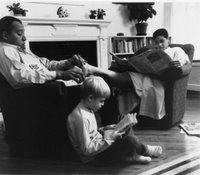 Yesterday I saw Kids (1995) with the 30 minute short Oreos With Attitude (1990). Oreos (directed by Larry Carty) was a very entertaining and subversive parody on race in New York City. A black couple are ambitious social climbers who make all the 'right' moves. They decide to adopt a white child (at any cost) because they don't want to risk having a child of their own who has a 30% chance of being darker than themselves. If white couples can adopt a black child, why can't they adopt a white child? The film details hypocrisy, deceit and superficiality in a very amusing way.
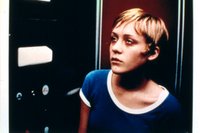 Kids was the first film by Larry Clark (of Ken Park fame) in which young actors Chloe Sevigny and Rosario Dawson also debuted. It was a grim but extremely honest portrayal of teenagers reckless about sex, drugs and violence, taking place in one day. Telly considers himself a stud and targets young virgins to charm and unleash his prowess. What he doesn't realise is that he is HIV infected. We know this because Jennie's (Sevigny) sole sexual encounter was with him, and she has been diagnosed positive.
It is a both gruelling and compelling two hours during which time we see Telly's and his buddy Casper's exploits. The ease with which Telly is able to seduce girls is realistically shocking, and should be compulsory viewing for teenagers' sex education (better than any educational video). The dangerous consequences of indisriminate sex and drugs is graphically portrayed.
It is a very bold film by the director as well as his young cast. Due to the OFLC's refusal to classify Ken Park, we haven't had the opportunity to see this film in Australia. But based on the director's work on Kids, I can see no reason why mature adults should not be able to see adult cinema of serious artistic merit.
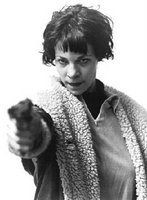 I had just enough time after Kids to take a walk around a very crowded Federation Square among the Diwali (Indian Festival of Lights) celebrations before going back into the dark of ACMI's Cinema 1 to see I Shot Andy Warhol (1996, directed by Mary Harron). This is yet another dark story, in which Lili Taylor takes centre stage as Valerie Solanas, a 60s radical lesbian advocating hatred towards men in her SCUM (Society for Cutting Up Men) Manifesto. She wanted Andy Warhol to produce a play she wrote. After being continually ignored, humiliated, and with her mental state declining, she shot him.
Taylor's performance was excellent, really inhabiting her role. I confess to not knowing much about Warhol, but Jared Harris played a good likeness. During the film, I couldn't help but think that this was like a female version of Factotum (a fictionalised misognynist Charles Bukowski). It was only later that I remembered that Taylor also played a significant role in Factotum.
None of the above films was perfect but definitely worth seeing. They are not subversive cinema per se, but they depict subversive characters or stories. They are all truly independent cinema, with originality, artistic merit and authenticity. In other words, not the sort of thing the serious cinemaphile has access to on the big screen on a regular basis (even at the so-called indendent cinemas). I would have liked to have seen The Notorious Bettie Page (it screened on Friday), but will hopefully catch another couple next weekend when the season comes to a close. Films still to be screened: The Safety of Objects, Office Killer, Velvet Goldmine, Go Fish and Swoon.
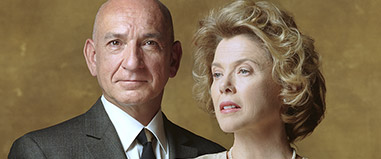 Based on a true story, it covers a society murder in 1980 of Dr Herman 'Hy' Tarnowner (Kingsley) by Jean Harris (Bening). The story is not in chronological order and there are some unusual if not inconsistent devices (some quite comical). While not an exceptional film, it is worth seeeing due to its unusual nature.
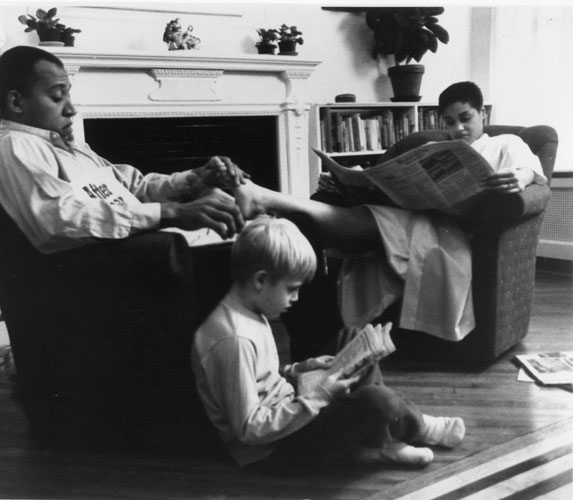 Yesterday I saw Kids (1995) with the 30 minute short Oreos With Attitude (1990). Oreos (directed by Larry Carty) was a very entertaining and subversive parody on race in New York City. A black couple are ambitious social climbers who make all the 'right' moves. They decide to adopt a white child (at any cost) because they don't want to risk having a child of their own who has a 30% chance of being darker than themselves. If white couples can adopt a black child, why can't they adopt a white child? The film details hypocrisy, deceit and superficiality in a very amusing way.
 Kids was the first film by Larry Clark (of Ken Park fame) in which young actors Chloe Sevigny and Rosario Dawson also debuted. It was a grim but extremely honest portrayal of teenagers reckless about sex, drugs and violence, taking place in one day. Telly considers himself a stud and targets young virgins to charm and unleash his prowess. What he doesn't realise is that he is HIV infected. We know this because Jennie's (Sevigny) sole sexual encounter was with him, and she has been diagnosed positive.
It is a both gruelling and compelling two hours during which time we see Telly's and his buddy Casper's exploits. The ease with which Telly is able to seduce girls is realistically shocking, and should be compulsory viewing for teenagers' sex education (better than any educational video). The dangerous consequences of indisriminate sex and drugs is graphically portrayed.
It is a very bold film by the director as well as his young cast. Due to the OFLC's refusal to classify Ken Park, we haven't had the opportunity to see this film in Australia. But based on the director's work on Kids, I can see no reason why mature adults should not be able to see adult cinema of serious artistic merit.
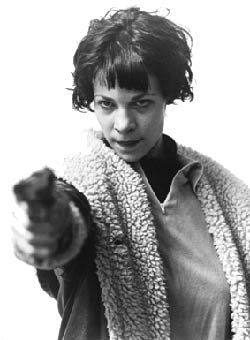 I had just enough time after Kids to take a walk around a very crowded Federation Square among the Diwali (Indian Festival of Lights) celebrations before going back into the dark of ACMI's Cinema 1 to see I Shot Andy Warhol (1996, directed by Mary Harron). This is yet another dark story, in which Lili Taylor takes centre stage as Valerie Solanas, a 60s radical lesbian advocating hatred towards men in her SCUM (Society for Cutting Up Men) Manifesto. She wanted Andy Warhol to produce a play she wrote. After being continually ignored, humiliated, and with her mental state declining, she shot him.
Taylor's performance was excellent, really inhabiting her role. I confess to not knowing much about Warhol, but Jared Harris played a good likeness. During the film, I couldn't help but think that this was like a female version of Factotum (a fictionalised misognynist Charles Bukowski). It was only later that I remembered that Taylor also played a significant role in Factotum.
None of the above films was perfect but definitely worth seeing. They are not subversive cinema per se, but they depict subversive characters or stories. They are all truly independent cinema, with originality, artistic merit and authenticity. In other words, not the sort of thing the serious cinemaphile has access to on the big screen on a regular basis (even at the so-called indendent cinemas). I would have liked to have seen The Notorious Bettie Page (it screened on Friday), but will hopefully catch another couple next weekend when the season comes to a close. Films still to be screened: The Safety of Objects, Office Killer, Velvet Goldmine, Go Fish and Swoon.
Subscribe to:
Posts (Atom)