Showing posts with label mystery. Show all posts

Saturday, March 13, 2010

French Film Festival 2010 - 9 (Bellamy)

Bellamy (Claude Chabrol, France, 2009)
Chabrol's reverence for Hitchcock is well-known and the influence is evident from the start of this film. Unlike a Hitchcock film, though, this is more about mystery than suspense, and it's more about the journey than the destination. The film's characters seem to inhabit a parallel universe, much like our own, but where they don't respond quite as you'd expect, confounding the audience but adding to and prolonging the mystery.

A man is dead under suspicious circumstances and the killer may or may not be known to a holidaying police inspector, Paul Bellamy (Gérard Depardieu, playing one of the best roles I've seen from him in recent years). The director strings us along, letting events unfold in no particular hurry. The very particular construction of the narrative sort of reminds me a little of the Alain Resnais films I've seen in that there's a very obvious artifice, an artifice that also bothered me a little in Chabrol's Nightcap/Merci pour le chocolat. I think I was wrong to expect realism in these films and my expectations blinded me to what is being conveyed.

I'm not claiming a mastery of understanding yet, but I sense that the Chabrol's intention is to play with the audience. The story is a puzzle, sign-posted at the outset with Bellamy attempting to complete a crossword puzzle. It also feels like a game of chess, with characters being moved across the board, circling and counter-circling, with various intrusions to our expectations. Our suspicions are sometimes aroused and we cannot always expect certain outcomes. Whatever the outcome - and I certainly wouldn't want to divulge it - there is a satisfying finale, if you're prepared for unconventionality. The performances in the film are all fine but it's the writing and direction that really shine. A warning, though - the film's ambiguity and unconventional story-telling won't be to everyone's liking. You must be able to suspend disbelief to appreciate the film.

Friday, July 31, 2009

MIFF 2009 Day 8 - 31/7/09

  • The Man Who Came With the Snow (Mohsen Makhmalbaf, Iran/France, 2009)
  • Une femme est une femme (A Woman is a Woman, Jean-Luc Godard, France/Italy, 1961)
  • Tony Manero (Pablo Larrain, Chile/Brazil, 2008)

The Man Who Came With the Snow
Nice-looking film that is made by an Iranian but set in a former Soviet country. The result: a film that has elements of Iranian cinema, such as the view of an adult world from a child's perspective, as well as the dark look of Russian cinema. In the middle of the night, a man escaping a blizzard enters a village hotel, disrupting the routine of these down-and-out whores, thieves and hustlers. Who is he? Where is he from? What is he doing here? A mystery, this is a nice festival film, something you won't see otherwise, and I like its relatively short length (about 75 minutes) - it's paced just right.

A Woman is a Woman
Another Godard, another soul-less film. Funny, yes. Smart, yes. Cutting edge (for it's day), yes but dated horribly. I sense that Godard feels superior to his audience. I don't perceive the anger with his audience that I do with others, but his films are distant and don't engage me. I'm still trying to understand Godard, and I really need to read Godard on Godard, which I will. Even understanding Godard's intent, I don't think will affect me. Godard doesn't aim to connect emotionally, he's looking for an intellectual or philosophical engagement. I don't watch films for that. For that, I read books or watch TV. Perhaps that's why Godard moved to television as his medium of choice.

Tony Manero
Sex, violence, disco - what more could you want in a film? Yeah, this is pretty weird and not what I was expecting. It's no Mister Lonely and it's no Red Faces (and if it was, I wouldn't want to be Red Symons). Our Tony Manero wannabe will do anything to win a look-alike competition - anything. The film is more social realist than anything and it has a pretty gritty (even grimy) look with hand-held camera work that is generally OK but sometimes a little too wobbly. The story is quite good but the visuals are a little spartan. It's OK for a festival film but I can't see how this could get a release other than being sold on its connection with Saturday Night Fever.

Thursday, July 23, 2009

The Limits of Control

The Limits of Control (Jim Jarmusch, Spain/USA/Japan, 2009)
Jim Jarmusch is quite simply one of the most interesting living film-makers working out of the USA. His latest film, The Limits of Control, is set in Spain with an international cast. There is at the core of his work a consistency of style and yet this latest outing represents a progression in the evolution of his body of work that is simultaneously understated and visually spectacular. One is never in any doubt that one is watching a Jarmusch film.

The Limits of Control is at least superficially a mystery. Designed like a Hitchcock spy thriller and oozing with a retro 70’s style that remains distinctly contemporary, characters behave like something out of an early James Bond movie or even Get Smart. There are secret passwords and the passing of small coded messages that are then swallowed. Knowing words are spoken cryptically: “Wait three days for the bread; the guitar will find you”. Despite sounding corny, it’s actually full of panache, though dark humour is (unsurprisingly) never far away. There’s also an element of film noir, including creative depictions of nudity.

The film is sparse with dialogue and characters speak languages different to each other. Sound familiar? It should. Language, communication and miscommunication seem to be recurring themes for Jarmusch. The very photogenic Isaach De Bankolé takes centre stage in the film and it is hard not to recall the scenario between his earlier character in Jarmusch’s Ghost Dog, a French ice-cream van vendor in New York, speaking not a word of English yet maintaining a friendship with the non-French speaking title character (Forest Whitaker).

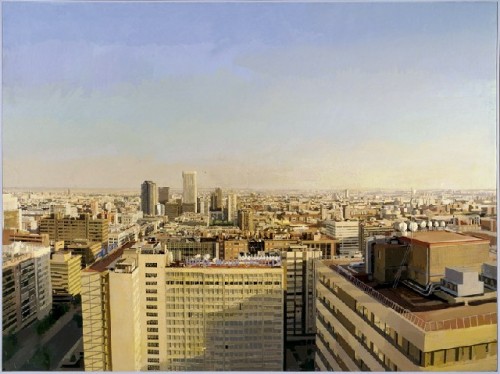
Because of the sparsity of dialogue, often the words spoken take on deep and cryptic meanings, bordering on philosophical: “I am among no-one”, “reality is arbitrary”, “the girl is a criss-cross”. The mystery deepens when the words seem to be reflected in what the protagonist sees at subsequent visits to the art gallery (Madrid’s Centro de Arte Reine Sofia), such as a girl’s figure in the shape of a cross. A personal exciting moment was when we get the protagonist’s point of view of the Madrid skyline, which then seamlessly transposes over the Antonio López painting, Madrid from Captain Haya, which he views. I instantly recognised this same piece from when it displayed last year at ACMI as part of the Kiarostami/Erice Correspondences exhibition.

The film is episodic, which we often find in Jarmusch’s films. Each episode involves a different character, in a different location, with different art production. I must say that the visuals are an absolute delight: colour composition and the use of the frame are awesome. There is nothing showy in Christopher Doyle’s stunning camera work, which uses an assortment of great angles, often static, and any movement used is masterful and restrained. The opening shot is, in fact, a very unconventional and skewed angle that takes a few seconds to work out what the protagonist is actually doing, and sets the tone of the film.

The film plays on patterns. There are visual patterns – some of the most arresting images you’ll see in a film – and there are narrative patterns, that repeat themselves and create an expectation in the audience. But each iteration is different from the previous and it’s satisfying to detect the subtle differences in each idiosyncratic repetition.

The film has an impressive support cast including Bill Murray, Tilda Swinton, Gael García Bernal, Hiam Abbass, John Hurt and others, but no-one is named. The credits merely describe them: Lone Man, Nude, Blonde, Guitar, etc.

** SPOILER ALERT **
I put the alert because you may want to discover for yourself without pre-empting: the film’s subtext is about the eternal struggle between those who love peace and art (including poetry, music, film, philosophy, etc) and the power-mongering politicians. That becomes evident as the story progresses and is cryptically underscored with the film's final message: "NO LIMITS. NO CONTROL."
** END ALERT **

The film is self-reflexive, an ironic (perhaps even comic) conceit that Jarmusch allows himself that recalls Wim Wenders’ The State of Things, in which Wenders’ stand-in, Patrick Buchau, talks about the use of black and white (in a black and white film). Similarly Jarmusch’s characters discuss techniques in film that he is demonstrating at that very point in the film. It’s a lot of fun.

Despite the familiarity, there’s something profoundly refreshing about Jarmusch’s films. It’s not just the visuals, it’s not just the wild characterisations that border on the comic, nor just the bizarre dialogue, nor the lack of exposition. Did I mention the fabulous sound design and music? Basically it’s all of the above, and how Jarmusch constructs the elements in a way that exceeds the sum of the parts. It makes this film fascinating. I have several Jarmusch films to catch up on, but of those I have seen, The Limits of Control is one of his very best and possibly the best cinema release of the year so far. It opens in cinemas today.

Monday, August 13, 2007

MIFF Day 19 (final day)

[Edit: comments to This Is England and The Silence have been added]

My final day of MIFF was pretty intense, but I was prepared for it by reducing the number of screenings I attended in the last week (two films on each of two days, one on each of the rest). Sunday saw me at four screenings, the most I've done in a day ever ("ha pooey", I hear some of you say, "I regularly do five, six or even seven!"). Well, four is a lot for me, and I'm not in a hurry to do it again.

I'm back at work, so time is a bit precious. I'm posting two reviews now, and will update this as I can with the others. Some time during the week, I'll also post an overview of MIFF.

Mister Lonely (Harmony Korine, UK/France, 2007)
In spite of some early projection problems and mixed reviews of Mister Lonely, the latest film by wunderkind Harmony Korine was not only one of the stand-out films for me at MIFF, but one of my favourites of the year thus far. My experience of his work to date is limited to his writing of Larry Clark’s Kids (1995, at age 20) and his directorial debut Gummo (1997). The former I saw relatively recently and impressed me with its gritty realism, while the latter surprised me on its theatrical release with its bleakness.

Mister Lonely is a much more colourful film than anything I’ve associated with Korine. Its visuals (such as set design, camera angles and cinematography) are very pleasing, accentuated by its seemingly unrelated parallel narratives and absurdist premise. A Michael Jackson impersonator in France meets a Marilyn Monroe impersonator, who introduces him to a Scottish commune full of various impersonators. While superficially the film appears to be frivolous, clearly it has deeper social comments to make about identity, loneliness and alienation, issues the director has been reportedly grappling with personally.

The other narrative relates to a group of missionaries in Panama, with Werner Herzog portraying a priest, Father Umbrillo, delivering food aid by plane, assisted by various nuns. While the connection between the dual narratives is unclear, this story is strangely surreal, visually alluring and entertaining. I've spent a week or so in Panama, including flying over the jungle in a small plane, but I didn't recognise the locale at the time (I thought it might have been the Caribbean).

There was a small flat spot towards the end of the film, but for most of the film’s 112 minutes, I had a big smile that was hard to wipe off my face. Charlie Chaplin, Shirley Temple, James Dean, Little Red Riding Hood, Queen Elizabeth, the Pope, The Three Stooges, Abraham Lincoln, Madonna and what I presume was a childhood version of Michael Jackson were all there.

The humour and irony are used with a clever and skillful blend of under- and over-statement. There is an underlying subtle sadness to some of the characters who, in spite of their eccentric alter egos, remain ordinary people that an audience can relate to. The film is intelligent and emotionally honest. One part is particularly close to the bone for me and brought tears to my eyes. This is probably Korine’s most accessible and enjoyable film. It deserves a theatrical release.

This was the second and final screening of Mister Lonely as part of MIFF's International Panorama. Link: Interview with Harmony Korine

Trailer for Mister Lonely
.


.

The Man From London (Béla Tarr, France/Germany/Hungary/UK, 2007)
Like Mister Lonely, this part of MIFF’s ‘Come to Cannes’ screenings of films that recently debuted at Cannes. And once again I was surprised at how good this was, considering I’d heard some negative or indifferent murmurs about it. It goes to show that you never can judge a film until you’ve seen it yourself. This is my first ever attendance at a screening of a Béla Tarr film.

The Man From London is clearly a highly stylised homage to film noir of the 1940s. The lush black and white photography, using classic noir shadows and imagery is a feast for the eyes. The camera work is slow, fluid and dynamic, with very long takes in which little seems to happen. Combined with a mesmerising score slightly reminiscent of Angelo Badalamenti’s sounds on Twin Peaks, a mood of ever-growing suspense and menace is created that powerfully engages from start to finish.

The basic premise of the film is that Maloin, a night harbour worker (played by Miroslav Krobot) witnesses some treachery between a disembarking passenger of a ship (the man in the title) and another man on-shore. A death may have occurred and when Maloin investigates, he becomes involved in an intrigue from which he cannot extricate himself.

Tilda Swinton plays Maloin’s wife, though her voice is dubbed over in Hungarian. The film was part-English produced, so maybe a name known to English-speaking audiences was required to market the film. The role was small, and I always find Swinton an interesting actor, so it was a curiosity to see her in this role. In general the tired and worn-out characters looked terrific on film, with a timeless quality that matched the aesthetics of the decaying town.

This is not a film for everyone, as it requires some patience and appreciation for aesthetics over action, and there is not a whole lot of the latter. While the film’s major strength is its visuals, they serve to subtly drive the slow-burn suspense. I was surprised when people started walking out of the film, first one by one, then after an hour about twenty or so walked out in unison. I estimate 60 people left, around 10% of the audience at the sold-out Forum screening. I was equally surprised that so few walked out of Inland Empire (I counted only four, about 1% of the also sold-out ACMI screening). Still, what’s a good film or a good film festival without walk-outs? Many of my favourite films have had them. I have read that this is not one of Tarr's best films. Well, I loved it and must seek out his others.

This was the second and final screening of The Man From London as part of MIFF's International Panorama.


This is England (Shane Meadows, England, 2000)
This is the third film I have seen by Shane Meadows, the others being TwentyFourSeven (1997) and A Room for Romeo Brass (1999). Both these films had a local theatrical release, though the latter I saw at MIFF in 1998. All three of these films are coming-of-age stories revolving around young males from poor working-class areas.

Reviews around town seem to be universally proclaiming This Is England as the best film yet by Shane Meadows. I disagree. I found the film very enjoyable, gritty at times and with some excellent performances (especially by thirteen-year old Thomas Turgoose as Shaun, and Stephen Graham as Combo), but it was no better than Meadows' solid drama in TwentyFourSeven, in which Bob Hoskins portrays a boxer who trains disadvantaged boys to keep them off the street.

This Is England is reportedly Meadows' most autobiographical film. Clearly he had a dismal upbringing, and each of his films is uplifting, probably a reflection of the director's raising himself out of despair. While some of the recent accolades proclaim Meadows as the natural successor to Ken Loach or Mike Leigh. Again, I disagree. All three directors often portray the same working class, but Meadows' films are clearly more optimistic than Loach and Leigh, more stylised and thus less naturalistic. His films are more accessible to mainstream audiences. I consider them good mainstream entertainment, whereas Loach and Leigh are definitely arthouse film-makers.

Was the film a good choice as closing film? I suppose the answer depends on one's criteria for selection. In support, the opening and closing night films are entertaining and relevant but I find it a little odd that both have been selected with theatrical releases so close to MIFF. Sicko opened on wide release on August 9 before the festival had finished, while This Is England opened on August 16.

Prior to the film's screening, there were addresses by Claire Dobbin, Gavin Jennings (the new Minister of Innovation, replacing John Brumby who has assumed the role of Premier) and Richard Moore. Jennings was the only speaker who spoke without notes; he is a very competent and humorous speaker.

The Silence (Tystnaden, Ingmar Bergman, Sweden, 1963)
The Silence was one of the four surprise screenings on the final day, a tribute to the recently departed Bergman. Unfortunately, This Is England finished late and I missed the first ten minutes or so of The Silence. While I'm told I didn't miss much, I felt a little disoriented at first and it took me a while to understand what was going on.

The film didn't engage me as much as the only other Bergman I've seen, Wild Strawberries. It did look nice and the tense perversity was handled well. As a film by a significant director, there's probably not a lot I can add at this point, but I look forward to exploring more of his works.

Link: Index of MIFF films reviewed

Wednesday, August 08, 2007

MIFF Day 14

Tuesday August 7, the day Inland Empire premiered in Melbourne at MIFF. And it was worth the wait. More below, and more to come when time permits.

Distance (Hirokazu Kore-eda, Japan, 2001)
This is the last of the Kore-eda screenings at MIFF. Time constraints prevent me writing in detail right now about this film or the retrospective as a whole, and I hope to do this some time soon. The film is very quiet and a bit of a strange beast as it's slightly obscure narrative unfolds, switching between at least three different time frames.

Basically, it's about people associated with a cult that was responsible for the mass poisoning of the water supply some years earlier. It's not concerned with the criminal act itself as much as the interactions between these five people. It has a common aesthetic with the other Kore-eda films, though each film in his body is very different from the others. Once the dust has settled on MIFF, I'd like to revisit this and all the other Kore-eda titles to appreciate them without the crowd of other films in my mind. Briefly, Distance is another quite but powerful film.

Distance was the final screening of the Hirokazu Kore-eda retrospective at MIFF.

Inland Empire (David Lynch, USA, 2006)
Where were you on Friday 13 July at 11am? I was at my computer at work booking tickets for Inland Empire. I was a man on a mission. To hell with the other 267 films - must... book... Inland... Empire. In my naivete, I feared the film would sell out on day one of tickets going on sale. In actuality, it took a week or two, the first film to completely sell out.

Last night I arrived at ACMI half an hour early to find a huge queue, the longest I have seen there ever. I was at the bottom of the stairs (the cinema is upstairs), and the ushers had managed to get the queue to spiral around the stairs, around the perimeter of the ACMI space until it wound up near the box office. It was a sight. I still managed to get a prime seat close to where I normally sit.

Well, was it worth it? Was I disappointed? Yes to the first and a qualified no to the second. Look, not only is this Lynch's most cutting edge film to date but I'm going to put myself out on a limb and say this is an historically important work. Whether cinema history will come to regard it as same, only time will tell.

Some of my anticipated fears were realised. I'm not a fan of digital film-making, though there have been notable exceptions. Last year's Em 4 Jay was my favourite film of the year, and it was shot on high definition digital camera. It wasn't evident to me at all, and I later learnt that it underwent an expensive labour-intensive transfer process to film, the first Australian film to achieve this (which was done by the lab at little or no cost to the production). Still Life's use of digital cameras was more evident but remains my favourite film at MIFF so far. (Incidentally, it's second screening had to be replaced last night when the print didn't turn up.)

Lynch films usually incorporate lush, vibrant visuals. His use of HD digital on Inland Empire is well-known, and reviews of the film from overseas had pre-warned me that this film would not share the same aesthetics. One online reviewer described the experience as akin to "looking through four screen doors". These types of reactions did prepare me, and I was able to cut the film some slack.

Lynch is using a new medium and he's not afraid to experiment. Not afraid? Hell, he's charged full bore into the medium with enthusiasm, pushing various boundaries, achieving new effects. Focus and composition are some of the obvious experimentations. Digital looks different, and Lynch has used a whole range of manipulations of the medium to try to harness it. Some aspects won't appeal to all, including myself.

It somehow doesn't sound quite right calling Inland Empire an experimental film, as those two words conjure up visual incoherence, an euphemism for something that didn't quite work or a project that belongs at a cinematheque rather than a regular cinema. Inland Empire IS an experimental film by a highly competent master. Any incoherence is more a matter of creative freedom that Lynch has allowed himself, more so than any other feature film with his name on it.

This film takes the surrealism and investigations of consciousness and identity in Lost Highway and Mulholland Drive, and ups the ante to a whole new level. Don't think you can come out of this film understanding it. You can't, and (as I wrote about Lost Highway) that I believe is the intention and part of the enjoyment of the experience. This is seriously freaky shit - much more so than Lost Highway, which until now I have considered Lynch's least accessible film (and, I might add, my favourite film of all time). So not only has Lynch experimented with a new medium, but he's also experimented with cinema narrative. This is why I think this film is so important, in spite of its flaws.

What is the film about, I imagine you asking. Already much reported, this is not easy to answer. All I can do is quote Lynch, it's about "a woman in trouble". Thematically, it is closest to Mulholland Drive. Laura Dern certainly puts in a remarkable performance, and this is well and truly her chance in the spotlight. Lynch is brilliant in his placement of actors. He intuitively knows that we have expectations of someone's screen history, and totally reinvents it by placing the actor in a completely different setting to what we're accustomed to. What Lynch did for Bill Pullman in Lost Highway he has done for Dern in Inland Empire. With due respect, I don't think either of these actors has done much of note with any other director.

It was great to see Grace Zabriskie (Sarah Palmer in Twin Peaks) in a small but powerful and convincing role, a little like some of the bizarre metaphysical characters from Twin Peaks or Robert Blake's Mystery Man in Lost Highway. Harry Dean Stanton, Jeremy Irons and Justin Theroux all had good support roles.

Lynch aficionados will recognise many of his other devices as he further explores themes developed in earlier films. While there's a common aesthetic to any Lynch film, Inland Empire deviates more than any other from what people have come to expect of him. The recognisable sound of Angelo Badalamenti's music is there, but less obviously. The brilliant fusion and placement of music is still there, but also used with mostly restraint yet at times extravagance, particularly the end. And speaking of the end, this one is truly different to anything Lynch has done, with a kind of homage that references the film itself as well as others, particularly Twin Peaks and Mulholland Drive. Speaking in strange tongues we have seen in Twin Peaks, but in this film we have a foreign language (Polish) at times, with subtitles.

In short - because this post is just about my initial impressions and I'll have more to write about Inland Empire after my second or third viewing (the DVD is on its way) - I think this is a brilliant piece of work by Lynch. It's not my favourite. It's probably even not in my top five. It is, however, an important film that commands respect. The digital medium has a long way to go, and Lynch is in the forefront of those pioneering the creative use of it.

I'm now racing out the door to see my next MIFF session. If I can make the time, I'm going to see Inland Empire again tomorrow night (even though the session is long sold out, my festival pass gives me a prime reserved seat if I choose to use it).

Inland Empire screened as part of MIFF's International Panorama. It screens again on Thursday 9 August at 9.15pm at the Forum Theatre. Official website.

Links: Index of MIFF films reviewed to date / MIFF website

Tuesday, January 23, 2007

David Lynch's Lost Highway

Some readers will know that Lost Highway is my all-time favourite film. I don't know if any other film can top it for me. That's not to say that an even more brilliant film cannot be made. But some kinds of magic can happen only once. Perhaps.

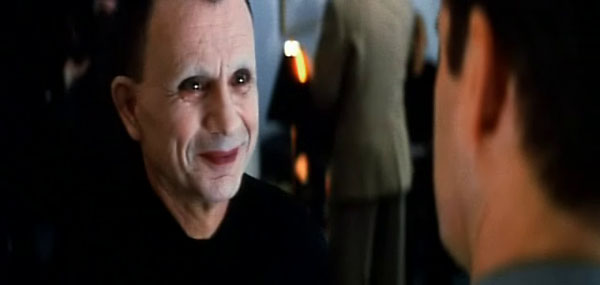
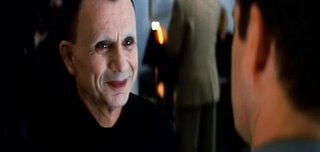
The Fred meeting Mystery Man scene (above) was part of the trailer that piqued my interest to see the film in 1997. That scene remains possibly my favourite scene from any film ever. Seriously twisted - mind-bending stuff!

I first saw Lost Highway around November 1997. I keep my movie tickets, but the Kino cinema in those days did not have the film title printed on them and I hadn't yet set up the film database I have now. This film left me in an altered state of consciousness; I left the cinema that Friday evening in a daze and it took me quite some time to come out of it. Some would argue that I'm still in it. Who am I to argue? Film will never be the same for me.

I spent many hours discussing the film with my significant other, as we tried to unlock the mysteries of what we had just seen. I had signed up an internet account six months earlier, and that weekend was the one when I really discovered what the internet was about. I spent most of it on Yahoo (remember, this was pre-Google) searching for answers. By Sunday afternoon, I was pretty confident that my understanding was in the approximate ball-court of Lynch's intention. It would take a second viewing to confirm it, though this was two years later at a screening at The Astor.

Lost Highway was my first exposure to Lynch. After seeing it, I hired on video (how quickly technology is moving; this was pre-DVD) every earlier film he'd made, as well as all 30 or so hours of Twin Peaks episodes(the first two seasons being my favourite TV series of all time). Lynch is, in my opinion, without equal, and remains my favourite director. His work is rare, if not outright unique, among commercially released cinema in its abstraction and its artistry. I consider virtually every piece of his work (with the possible exception of Dune) at least brilliant, and many as masterpieces. Other favourites include Eraserhead, Blue Velvet and Twin Peaks: Fire Walk With Me.

I mentioned in my Year in Review how during 2006 I became a committee member of Melbourne Cinémathèque. During the year I volunteered for the task of printing 100 copies of each week's film annotations as they appear on Senses of Cinema, for distribution at the screenings. When Lost Highway came up, there were no reviews appearing at Senses of Cinema, so I volunteered to write an article. The result was my first serious film review. Serious in the sense that it was of a considerable length (over 2,000 words) and that it had an public audience of serious Melbourne cinephiles. The following was that review as distributed on the evening of October 4. Also screening on the night was the great Lynch classic, Eraserhead.


Lost Highway (1997 USA 135 mins)

Prod Co: CIBY 2000, Asymmetrical Productions Prod: Deepak Nayar, Tom Sternberg, Mary Sweeney Dir: David Lynch Scr: David Lynch, Barry Gifford Phot: Peter Deming Ed: Mary Sweeney Mus: Angelo Badalamenti Sound: David Lynch, Sasumu Tokunow Prod Des: Patricia Norris

Cast: Bill Pullman, Patricia Arquette, Balthazar Getty, Robert Blake, Robert Loggia, Gary Busey
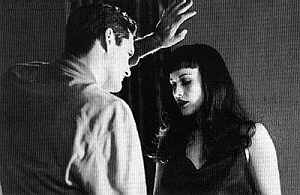

Fred Madison (Bill Pullman) is a man with an identity crisis. He may or may not be who he appears to be and may have committed a terrible crime. David Lynch describes him as “a kind of a regular guy. He’s smart and he could be someone in trouble – a lot of trouble”1 and “lost in confusion and darkness, where fear is in the driver’s seat”.2 Thus begins the dark, mysterious journey of Lost Highway.

Lost Highway is perhaps Lynch’s most ambitious and least understood films, and a favourite among many of the fans of his work. Its mysteries are so dark and seemingly impenetrable, that even if you don’t understand them (and due to the use of various devices3, no-one can understand them fully), you can thoroughly enjoy the experience of not understanding. The mysteries linger long after the credits have finished rolling, an essential part of the experience.

The film’s genesis was simply the evocative two words of the title4 that were used in a novel called Night People by Barry Gifford. The words intrigued Lynch who developed some initial ideas that were further developed with Gifford as co-writer. Their previous collaborations include Hotel Room, a short TV series (directed by Lynch, written by Gifford) and Wild at Heart (written and directed by Lynch, based on Gifford’s novel).

Lost Highway contains many secrets – secrets that both Lynch and Gifford are reluctant to divulge. According to Gifford, “things happen in this film that are not – and should not be – easily explained”5. Lynch has always been hard to pin down about specifics of his films. He wants viewers to make their own interpretations and has been variously quoted as saying: “I don’t like to talk about things too much because, unless you’re a poet, when you talk about it, a big thing becomes smaller”6, “a mystery is like a magnet. Whenever there is something that’s unknown, it has a pull to it… when you only see a part, it’s even stronger than seeing the whole”7 and “If things get too specific, the dream stops.”8

Even the two writers have different interpretations of the film and did not discuss in detail the meaning. Says Lynch:

“Barry may have his idea of what the film means and I may have my own idea, and they may be two different things. And yet, we worked together on the same film. The beauty of a film that is more abstract is everybody has a different take… When you are spoon-fed a film, more people instantly know what it is. I love things that leave room to dream and are open to various interpretations. It's a beautiful thing. It doesn't do any good for Barry to say 'This is what it means.' Film is what it means. If Barry or anyone else could capture what the film is in words, then that's poetry.”9

Lost Highway opens to the imposing sound of Deranged by David Bowie. Car headlights illuminate road lines passing at breakneck speed in the night, as if in flight. A frenetic mood is immediately established10. Cut to Fred quietly at home, drawing painfully on a cigarette. Every breath is an effort. A sense of numbness pervades – this is not a man in control.

The door buzzer goes off, and a voice on the intercom: “Dick Laurant is dead”. This scene was based on a real-life event involving David Lynch, in the Hollywood Hills house depicted in the film (which is his sound studio). One morning he awoke to the door buzzer and those words came over the intercom. The front door is not readily visible, and Lynch had to go to the far side of the house but could see no-one.

Video tapes start arriving on the doorstep. The first shows the outside of the house. Fred’s wife, Renee (Patricia Arquette) says vacantly, “must be from a real estate agent”. “Maybe,” says Fred blandly. There’s a silent tension between the couple and a gloom intensified by long takes and visuals of long, dark hallways that appear to swallow people whole. Words are sparse and hang in the air like a thick, toxic fog – no marital bliss here.

Interestingly, Michael Haneke’s recent Hidden (Cache) – a very different film – pays homage to Lost Highway. In Haneke’s film, video tapes similarly arrive on the doorstep of the Laurants. In one scene, the door bell rings, but no-one is there. Like Lost Highway, there is a suspicion of infidelity.

The tapes become more sinister, and a morbid sense of unease grows, before the film takes a critical, mind-bending left turn. Something happens that completely defies logic. In prison, a warder says to the captain, “This is some spooky shit we’ve got here.” (The film is full of terrifically black humour and dialogue).
Lost Highway’s sub-title is “a twenty-first century noir horror film”. Lynch liked this description because the film crosses various genres: noir, horror, thriller and mystery, if not others. But mostly it’s a mystery. CIBY-2000’s marketing described the film as “a psychogenic fugue”, referring to an actual condition. This description appealed to Lynch, though he had no knowledge of that pathology when he made the film.

Lynch, started as an artist before accidentally falling into film. According to Lynch, “many of the things that you subconsciously use in painting, you use in film.”11 Lost Highway is like a work of abstract or surrealist art. There are various layers of reality, fantasy and abstraction that are not immediately differentiated. The film switches effortlessly and inexplicably between alternate realities, between hyper-realism and mundane, and musically between the beautiful compositions of Angelo Badalamenti, coarse industrial sounds and the heavy metal music of Rammstein.

Sound is an important component of a film for Lynch, who is highly involved in this aspect. “Half of the film is picture,” he has said, “the other half is sound. They've got to work together. I keep saying that there are ten sounds that will be correct and if you get one of them, you're there. But there are thousands that are incorrect, so you just have to keep on letting it talk to you and feel it. It's not an intellectual sort of thing.”12 The film has a killer soundtrack, which was produced (uncredited) by Trent Reznor of Nine Inch Nails. One track is by Marilyn Manson, who appears in the film as a porn star.
No-one does sex and violence like Lynch: the mutilation of a victim (glimpsed in flashes), the tailgating incident with Mr. Eddy, the death-by-coffee-table, Alice’s first meeting Mister Eddy, the Death Valley desert sex scene (which was truly sublime). “You will never have me”, says Alice. And the story unravels into a sense of lost control. There is a bizarre fleeting reference to the Wizard of Oz – events whirl past as from within Dorothy’s Kansas tornado.

Casting was brilliant in Lost Highway. For Pullman, it was perhaps the performance of his career. Usually playing everyman roles, he splendidly depicted a man confused and in crisis. Arquette was perfect for the role – sassy and just a little bit nutty. Robert Blake (Mystery Man), asked by Lynch to just be himself, was creepy, enigmatic and added an unexpected sense of menace. Lynch cryptically described his role as “a hair of an abstraction.”13

Robert Loggia missed out to Dennis Hopper in playing Frank Booth in Blue Velvet. Loggia exploded at Lynch after waiting a long time to audition on a hot day without getting the opportunity to try out. “I thought there’s not a rat’s arse chance that I’m gonna be in [Lost Highway],” he said, “because David Lynch has got to remember that happening and not want a damn thing to do with me. But paradoxically, I think, my berserk meanness or junkyard dog, ferocious, rabid attitude made me for what David had in mind for Mr. Eddy.”14

During filming, the actors had trouble making sense of what Lost Highway was about. Lynch said little about the meaning of things and divulged only as much as an actor needed to know to play a particular part. Sometimes an explanation would be given one day, only to be confounded by contradictory information the following day.

Lynch has many trademark devices commonly used in his films. Some of these appear in Lost Highway:industrial sounds, very long takes, times of sparse dialogue, distorted reality, fire and smoke, the colour red, song or music as a small part of the story (Fred is a saxophone player), singers playing roles (Marilyn Manson, Henry Rollins), quirky characters and situations15, the supernatural , glimpses of unclear nightmarish images, lack of distinction between reality and dreams or imagination, unclear motives and outcomes, timeless retro style, revelations of the dark underside of seemingly normal situations, characters that lead dual lives, lack of easy explanations, and the use of actors outside their normal comfort zones.
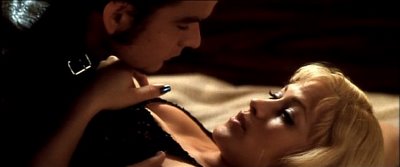
Lynch makes anything but stereotype films, yet uses many of the hackneyed devices of Hollywood, but in a distorted, stylised or exaggerated manner – sort of out-Hollywooding Hollywood. “The whole thing is the idea,” says Lynch, “and ideas are the best thing going.”16 “It's all just fantastic,” says Gifford. “It's sort of beyond black humor. Because we had this freedom of being in a fantasy world, more or less, we could do anything. If spaceships came down, which they practically did, it wouldn't be out of context, given where we're at. That's a tremendous structure; I don't know if everyone understood it once we sprang it on them.”17

There are many mysteries in Lost Highway:

  • Is Renee having an affair?
  • Are Fred and Pete the same person?
  • Are Alice and Renee the same person?
  • Did Fred actually leave prison?
  • Who is the Mystery Man?
  • How can he be in two places at the same time?
  • Who made the video recordings? Was it the Mystery Man?
  • How did Pete hurt himself?
  • What happened ‘that night’?
  • What is real? What is not?

If the film resonates with you, you’ll be asking questions long after the film ends. It is the ambiguity that Lynch’s films afford that makes them so enjoyable, and what makes his work truly unique. Lost Highway defies description – it defies the laws of logic and narrative – it can only be experienced. Or, as Lynch said, “They come out with a strange, fantastic feeling and they can carry that. It opens some little door or something that's magical and that's the power that film has.”18

This is mind-altering cinema – a true masterpiece and the work of a genius. Arquette has said, “You feel David in his movies. It’s another universe he takes you to… it’s like an alternate reality; it’s close enough to our own to be really disturbing.”19 And, says Lynch, “I keep hoping people will like abstractions, space to dream, consider things that don't necessarily add up.”20


THE FOLLOWING CONTAINS SPOILERS! I normally abhor spoilers but include them here as an exception to the rule. I have discussed Lost Highway with many people over the years – most people liked it a lot, but hardly anyone understood it. There are some critical keys to understanding the main mystery of Lost Highway. First I want to present some of those keys, and then I will give my take on what those keys reveal. I do, however, recommend that you only read ahead once you have seen Lost Highway, and allowed yourself quite some time to digest it.

The keys:

  1. Fred says to the detective: “I like to remember things my own way”. This gives an insight into Fred’s mind.
  2. Just prior to the identity swap, Fred has a vision of Pete on the front lawn where something distressing was happening.
  3. In Andy’s house, Pete sees a photo of Renee and Alice together. Later, only Renee is there. This is perhaps the biggest clue.
  4. Pete has flashbacks that include the crime scene.
  5. Two realities: at the start, Fred’s life is so mundane – this is reality. In Pete’s world, everything is fantasy – all the interactions are like a bad Hollywood movie. For example:

  • Mr. Eddy's car gets smashed up but with no visible damage
  • Alice’s instructions to Pete to rob Andy
  • Andy’s death
  • Fred’s sex life was mediocre and unsatisfying; Pete’s was pure fantasy. After sex, Renee gives Fred a consoling, but condescending pat on the back. “It’s OK,” says Renee but Fred retreats in silence. There’s nothing erotic in this relationship. Pete, on the other hand, “gets more pussy than a toilet seat”.

Gifford has said, “any kind of explanation is going to be inadequate, because a film is made to be seen.”21 However, there is a fairly straightforward answer to what happens to Fred. He never left prison. When we last see him in prison, he is ‘losing it’. Everything from this point on is fantasy. Pete is everything Fred would like to be: young, virile and desirable. But even in his deluded state, Fred can maintain the fantasy for only so long.


1 Interview with David Lynch on Lost Highway DVD

2 Chris Rodley, Lynch on Lynch, Revised ed. 2005, p.243

3 Some devices appear to have no particular meaning, red herrings perhaps. They are like the abstractions in our minds, the rantings that make no particular sense.

4 Mulholland Drive was similarly inspired by the two words that make up the title. Incidentally, the tailgating scene with Mr. Eddy in Lost Highway took place on Mulholland Drive.

5 Rolling Stone magazine, March 6, 1997, as quoted at The City of Absurdity: David Lynch’s Lost Highway

6 Rodley, p.227

7 ibid, p.231

8 Quoted by Brad Stevens, Discovering David Lynch`s Lost Highway

9 Quoted by Frederick Szebin and Steve Biodrowski, Cinefantastique Volume 28, Number 10, April 1997, posted at LynchNet

10 Lynch has said that the opening sequence came to him when he heard this song.

11 Interview with David Lynch, Lost Highway DVD

12 Quoted at The City of Absurdity

13 Rodley, p.229

14 Interview with Robert Loggia, Lost Highway DVD

15 Lynch is the source of inspiration for a flood of TV and film quirkiness that seems to be proliferating since the mainstream success of Twin Peaks. None of these imitators come close to the sublime and non-self-conscious achievements of Lynch.

16 Interview with David Lynch on Lost Highway DVD

17 Quoted by Frederick Szebin and Steve Biodrowski, Cinefantastique Volume 28, Number 10, April 1997, posted at LynchNet

18 David Lynch Biography, IMDB

19 Interview with Patricia Arquette, Lost Highway DVD

20 Quoted at The City of Absurdity

21 Rodley, p215