Showing posts with label Spain. Show all posts

Sunday, April 11, 2010

The Week in Review - 11/4/10

I can't believe I saw ten films this week. I'm not working at present and had four days where I saw 2 films each day. This was also partly due to Easter and partly because of the Festival of German Films preview screenings (I'm posting separately about these).

The stand-out of the week is Animal Kingdom, which will definitely make my top 10 of the year. This film is going to sweep the AFI awards this year and is as good a film as Samson and Delilah. The only other new release so far this year that is every bit as good is Jacques Audiard's A Prophet/Un prophète. It seems that Madman are trying some new strategies in their marketing and invited a small number of reviewers - mostly bloggers and those with a web presence - to a screening ahead of the media preview. The film has lingered and consumed me more than any film has for a long time. I'll post my review on it separately in a day or two.

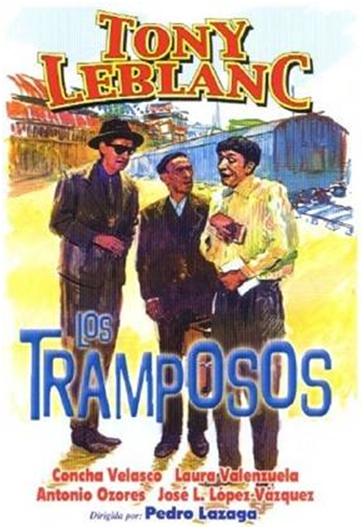
La Mirada ended, and I attended the final screening, not realising it was the closing night film. It cost me $24, and I didn't stay for the after-party - ouch! But The Swindlers (part of Almodóvar Presents) is a lot of fun and it was great to see this film, screened for the first time in Australia.

FILMS:
  • Atraco a las tres (Robbery at 3 O'Clock, José María Forqué, Spain, 1962)
  • Welcome (Philippe Lioret, France, 2009)
  • The Eclipse (Conor McPherson, Ireland, 2009)
  • Figuring Landscapes: Enactment (Patricia Piccinini, Ben Rivers, Margaret Tait, George Barber, Tammy Honey, UK/Australia, 2008)
  • Animal Kingdom (David Michôd, Australia, 2010)
  • Kick-Ass (Matthew Vaughn, USA/UK, 2010)
  • Whisky mit Wodka (Whisky with Vodka, Andreas Dresen, Germany, 2009)
  • Die Wölfe: Nichts kann uns trennen (The Wolves of Berlin: Part One - Nothing Can Part Us, Friedemann Fromm, Germany, 2009)
  • Los tramposos (The Swindlers, Pedro Lazaga, Spain, 1959)
DVD:
  • Schwerkraft (Gravity, Maximilian Erlenwein, Germany, 2009)

Robbery at 3 O'Clock
The Spanish academic who introduced this film mentioned it is widely regarded as the best Spanish comedy ever. Well, claims like that are always debatable, aren't they? It's largely a matter of taste. I don't know if I'd put it on such a high pedestal, but I can understand why historically it might be considered with high regard. After all, a film needs to be considered in the context of when it was made, something that described in the introduction.

Spain in 1962 was a pretty dark place. It was more than twenty years into a dictatorship that capped off a long and devastating civil war. This film gave the Spanish some ray of light, some joy and it is a lot of fun to follow a rag-tag bunch of bank employees plot to rob the branch they work in. The film's opening sequence makes clear what its influences are with a dialogue-free sequence that is pure Charlie Chaplin farce.

I imagine the film would be more enjoyable for a Spanish speaker, who would better understand the nuances of the language - apparently some of the dialogue was absorbed into popular Spanish culture at the time. The film makes a slight swipe at the government at the start of the film but is otherwise largely apolitical. We were told that this was the film's Australian premiere and was part of Almodóvar Presents at La Mirada.

Welcome
There's something distinctly unsatisfying about this film, and it nagged me most of the way throughout its length. It's one of the films from the French Film Festival 2010 that I decided (fortunately) to wait for its theatrical release. I've heard mixed things about it, and I'm definitely in the camp of the disappointed.

I was similarly disappointed with Lioret's previous Je vais bien, ne t'en fais pas/Don't Worry, I'm Fine which at least had the benefit of a quietly simmering performance by the wonderful Mélanie Laurent. Both films tend towards earnestness, overly so. They both have an arthouse aesthetic, both with human issues, but the issues are too overt - especially in Welcome.

Welcome, I'm sure you're aware, is about a young Iraqi who has found his way to France and is wanting to get to England to join his girlfriend. Failing to cross by truck, he meets up with a swim coach, learns to swim and plans to swim the English Channel. On the one hand, the film draws attention to the far-right neo-fascist policies of Nicolas Sarkozy, that would have been adored by John Howard, that criminalise any citizens that assist refugees in any way. I agree with the left-leaning (ie, social/humanist) policies the film is endorsing, but I don't need it thrust down my throat so overtly. Michael Winterbottom did it much more successfully (and seriously) with his In This World (2002), a much more timely film.

Lioret's film is much safer, clearly designed to appeal to a more mainstream audience - not that there's anything wrong that per se. It's just that with an added element of a domestic story, it all feels more than a little contrived, melodramatic and overtly appealing to our heart strings (especially with the use of music). It's the sort of film that probably did well at the French Film Festival or, post-festival, with the prime Palace demographic.

Another problem for me is Vincent Lindon in the main role of swim coach. Maybe it's my prejudice, but I don't like his looks for a role like this. He often plays a Mr. Everyman, which is what's asked for here. The trouble is, he doesn't come across as a Mr. Everyman. His acting is quite wooden, his face is largely expressionless and he has too narrow a range to effectively portray his character in this film. About the only roles I find him effective in are as a criminal. Otherwise, I normally see the actor and not the character.

For me, a film that exemplifies a much more satisfying depiction of an 'issue' is Michael Haneke's Caché/Hidden in which an Algerian massacre in France takes backseat to a contemporary story filled with ambiguity. Haneke assumes his audience will 'get it' without being preached to like Lioret's film does.

The Eclipse
This is quite a decent and thought-provoking film from the Republic of Ireland, set and filmed in Cobh, Cork County. Michael (Ciarán Hinds) is a single father grieving for his deceased wife. Hinds' is perfect for the role and his performance is spot on. He has a melancholy presence that conveys a repressed emotional burden. All is not perfect in his world, and a ghostly presence seems to be lingering. Is it his wife? Has Michael not let go of her? Or is it his elderly father-in-law, still alive, but on the precipice?

The film is not conventional horror - which is largely puerile, aiming at a teenage demographic. It's not really an adult ghost story, either. It crosses genres and really stands up predominantly as drama. The supernatural elements take up a small proportion of the film's screen time, but add an ever-present ambiance that looms in the background. The naturalistic lighting, tending towards darkish, accentuates the sombreness.

Michael is a regular volunteer at the local writers festival, during which he finds himself driving around the celebrated English author of The Eclipse, a book about ghostly experiences by the attractive author Lena Morelle (Iben Hjelje). Michael has the perfect opportunity to talk about the disturbing phenomena in his house, but is reluctant to completely open up. This scenario is perfect for a slow burn drama as various intertwining relationships unfold, involving another celebrated writer, Nicholas Holden (Aidan Quinn).

The performances of the lead characters are all strong all and the story is multi-layered, covering various themes, including grief, lettting to, celebrity and human relationships in general. If anything, it could be accused of being slightly over-ambitious to its detriment, but this is a minor complaint.

Michael's role as driver gives the film the opportunity to display the Irish countryside and townships, and these visuals of the architecture and scenery are just superb, without being postcard cliches. It's one of the things I love about world cinema, experiencing other places in some small way.

The supernatural element is used with restraint for the most part - The Others comes to mind, but that film was much more ghost-orientated. So horror film buffs might be disappointed. The Eclipse really aims at a more conventional arthouse audience with its solid dramatic themes, with the supernatural more an interesting variance on the genre.

As an aside, for me ghosts are a given, something I've experienced for as far back as my memory allows (at least since age two). I've never seen ghosts depicted in cinema quite as I've experienced them, but that's because I've never seen them physically but rather sensed them, or 'seen' them by my 'third eye'.

It's hard to convey, but there was a ghost that regularly visited me in my dreams all throughout my childhood. In my sleep, he assumed a form like a wolf and would breathe up close onto my dream body's face - a sort of dream within a dream. His breath stank like fish and hearing him would scare me. If, within my dream, I realised that my dream body was not real and it was just a dream, eventually he would go away. Mostly though, he would fool me and if my dream self woke up, them my real self would also wake up and I would have wet the bed. This continued until around age ten.

I was living interstate at age 23 when this same entity visited me again, when I was travelling away from home. I instantly recognised him when he appeared in my dream and, without waking up, I threatened him and he quickly disappeared. I later learned that there is no need for threats because ghosts are very insecure and will leave if asked to. Since that time, on the rare occasions when I've senses another entity, I've done just and they have always left without incident.

Actually, when I was nineteen years old, I was attacked by a ghost when I was sleeping under the stars along the Nullabor Plain. I was just drifting into sleep when I saw shooting stars which, according to Indian belief, are a bad omen. Fear gripped me at a vulnerable time and the next thing I knew, an entity was choking me. I warded it off mentally and it disappeared, leaving me a little traumatised.

I still sometimes sense entities around at night when I'm going to bed and often do a mental visualisation to protect myself. This involves asking all uninvited guests to please leave and any well-wishers may remain. Call them guardian angels if you like, but I have seen them while wide awake. I understand those without similar experiences may find this kooky or superstitious; for me it's just a innate part of my understanding and contributes to my perspective of life and death, something I alluded to in my post 'A Change of Plans'.

For the best part of thirty years, I've been left pretty much alone by ghosts or entities. I don't really call them ghosts, which implies they're a different type of being to us. The term 'entity' seems more appropriate - I see them as being people like you or I, but unembodied for whatever reason). I attribute my being left alone to my coming into my own power, understanding them and understanding myself relative to them.

Figuring Landscapes: Enactment
What can I say - experimental/conceptual art cinema usually does nothing for me. I thought I'd give this a go, but it was the same. So far, I haven't been able to penetrate that space.

Kick-Ass
A lot has been written about this very entertaining film. Some of the superlatives have been over the top, but it definitely is one of the best in its class. It's certainly not what the marketing of the film would have you believe it is. While the writing is very good, I think the film's success is the amazing performance and sneering charisma of the then eleven year old Chloe Moretz as Hit Girl. She steals the show and it wouldn't be the same without her. And even Nicholas Cage gives a decent performance (something he hasn't done since Adaptation and Bringing Out the Dead).

The Swindlers
This is a nice little vintage gem from the vaults of Spanish cinema, beautifully rendered in colour. Pedro Almodóvar selected this film for La Mirada and I can see how its "sardonic humour" (as festival director Rocio Garcia described it) would be right up his alley. It's right up mine, too. Three friends collude to con people out of money by any means they can but go straight to win the affections of a girl. The script is sharp, the performances good and the ending is just great.

Sunday, April 04, 2010

The Week in Review - 4/4/10

I haven't mentioned much yet about this year's La Mirada, one of my favourite local film festivals. I filled in a survey at the festival today at ACMI and for the question about what I like about the festival I put: [festival director] Rocio Garcia's passion and love for cinema (she introduces most of the films), the volume of door prizes, the atmosphere, the Almodóvar curated section and the pre-recorded intros by the respective film directors. That pretty much sums up for me why I go to the festival. A couple of years ago, I missed a real gem, In the City of Sylvia, which thankfully I caught at Melbourne Cinémathèque last year. Today I saw a similar gem, Paz Fábrega's Agua fría de mar/Cold Water of the Sea. More on this below.

During the week, I've been previewing some films for the Festival of German Films. I'll post a separate article on these films in the next week or two. Hopefully by then, I'll have my thoughts in writing on at least seven films, leading up to the festival's opening on 22 April.

FILMS:
  • Tesis (Thesis, Alejandro Amenábar, Spain, 1996)
  • Agua fría de mar (Cold Water of the Sea, Paz Fábrega, Costa Rica/France/Spain/Netherlands/Mexico, 2009)

DVD/BLU-RAY*:
  • *Léon: The Professional (Luc Besson, France,1994)
  • The Most Dangerous Man in America: Daniel Ellsberg and the Pentagon Papers (Judith Ehrlich/Rick Goldsmith, USA, 2009)
  • Big Fish (Tim Burton, USA, 2003)
  • Die Tür (The Door, Anno Saul, Germany, 2009)
  • Die Standesbeamtin (Will You Marry Us?, Micha Lewinsky, Switzerland, 2009)
  • John Rabe (Florian Gallenberger, France/China/Germany, 2009)

Thesis

This film interested me because (1) it's part of La Mirada's Almodóvar Presents. For me, Almodóvar's films provoke much discussion, even though (as I've often mentioned) I am greatly ambivalent about the films - see my post on Volver for more on that. And (2) because this is the first feature film by Alejandro Amenábar, director of such celebrated films as Abre los ojos/Open Your Eyes (remade as the inferior Tom Cruise vehicle, Vanilla Sky) and The Others (with the then Mrs. Cruise, Nicole Kidman).

What an impressive debut it is. According to festival director Rocio Garcia who introduced the film, Amenábar was only 23 years old when the film was made, still studying at university. He wrote, directed and composed the music. It's no high art, but a fabulous homage to cinema, and Hitchcock in particular. A female film student is doing a thesis on violence in the media and stumbles across a snuff film, leading to a dangerous journey in which her life is seemingly put at risk.

This is B-grade film-making at close to its best, and I mean that in the nicest possible non-disparaging way. The plot is pure B-grade. It's predictable and cliched (like the best Hitchcock films are), yet the writing is strong enough to capture your emotions anyway and I remained in suspense for the film's duration, even if it is slightly overlong. Despite this simple premise, Thesis works on other levels, too, for example questioning the audience's fascination with violence in film (something Haneke does in a more oblique and intellectual manner).

Amenábar demonstrates a great deal of film literacy, especially at so young an age. Being about film studies, students and teachers, he infuses the film with technical aspects of film-making and there are many filmic references. It was a blast to hear an academic deliver a lecture about what was wrong with Spanish cinema and what it needed, mirroring recent introspective discussions here about what's wrong with our industry. For the record, the academic was promoting the need for films to appeal to audiences, to attract bums on seats. Very familiar, indeed. Bear in mind that this was made fourteen years ago. I let out a big laugh at the time, and I'm sure those that heard me had no idea why.

There's a roughness, a crudeness, about this film that gives it both a bite and immense appeal, an appealing aesthetic. It's great to see what an inexperienced but talented film-maker can do on the smell of an oily rag. Not unlike Almodóvar, for that matter. The subject matter - the making of snuff films - is also challenging at times. Fortunately, the horror aspects are brief, just enough to put the fear of god into us at certain times, ratcheting up the suspense as we ponder what might transpire. Again, this is no high art, but well-worth seeing as part of Amenábar's oeuvre, to see where he began. It demonstrates that his later successes were no accident.

Agua fría de mar
I was in two minds about seeing this film. There's few reviews online, which appear mixed. In the end, I went with gut instinct and thought I'd take a risk because the film also appeared to take risks. La Mirada director introduced the film, mentioning that the festival is screening films by eight first time directors this year, including Agua fría. This film was a last minute inclusion after the festival's programming had already been concluded, which caused much inconvenience for rescheduling. Now, this is not a mainstream film - think Jose Luís Guerin, Pedro Costa (without his bleakness) or Lucrecia Martel (La mujer sin cabeza/The Headless Woman) - so my already high regard for Rocio Garcia expanded to an increased respect for her selection in cinema after seeing this.

So, as you can probably tell by now, I was impressed by this film. It has a minimalist aesthetic similar to the films by the above-mentioned directors, an understated confidence in story-telling without gimickry or overt manipulation, and a lovely eye for visuals that added perfectly to a particular ambience - and all with little or no music, other than what appears organically within the narrative and a cast of largely non-professional actors.

The film employs devices consistent with the concept of 'contemplative cinema' with long static takes in which not a whole lot seems to transpire. One has to 'enter the zone', skip to the film's pace, so to speak, and one can't help but take notice of visual details and sounds. One near constant is the rolling thunder of the waves - sometimes near, sometimes far - which maintains a specific sense of place. The film combines intertwining stories of two families on holiday by the sea. I've not been to Costa Rica but imagine the climate would not be dissimilar to neighbouring Panama, which I visited in 1987.

The film was introduced via pre-recorded video by the director and lead actress, both incredibly young. Paz Fábrega mentioned that the theme of the film is about young people not really knowing what their path in life is. Of course, the same can be said for those of us who are twice her age, but point taken. That's one thread through the film, which is deftly portrayed with much nuance, understatement and ambiguity.

Part of the film's appeal for me is the loose ends - there's no tidying up of issues, or even explanation of issues, leaving much to the imagination. There's another element of contemplative cinema - we are left wondering, speculating, trying to join the dots after we've left the cinema.

The other family thread in the film involves a family with four children, and the youngest goes missing one night. The film has an almost fly-on-the-wall element as we observe the seemingly mundane details of their interactions, the way they relate to each other. There's a sort of frustration, watching some dysfunctional interactions that we are helpless to intervene with. There's no sign-posting of this, and unless one is aware of the issues in real life, one may not recognise the significance within the film. Isn't this what good cinema is about? We each draw something according to our own experiences or wisdom, possibly drawing different conclusions which may be equally valid.

The camera work in the film is superb: the blend of static shots and skillful use of hand-held, unconventional angles and some truly unique visuals, such as hundreds of poisonous sea-snakes washing up on the beach which is full of children playing in the water and digging in the sand. It's a pity then, that we only got to see the film in DigiBeta. I presume it's because it was acquired for the festival at short notice, but I'd happily see the film again if a 35mm print was available. Maybe MIFF will pick it up - it or Melbourne Cinémathèque would be perfect platforms for a film of this calibre.

While the film could be seen as boring to a conventional audience (not a real lot happens on the surface), the dramatic drive comes from the intersection of the family and the couple, involving a deception which we are aware of but the protagonists aren't. It's pure visual poetry and more. And, for what it's worth, Rocio Garcia mentioned that this is the first film at La Mirada from Costa Rica. It's also the only film from Costa Rica I've ever seen. Paz Fábrega - keep your eye out for that name.

Léon: The Professional
Released here as just The Professional, I enjoyed this film when it was first released and was surprised to recognise one of my favourite American actresses, the one and only Natalie Portman, as a teenager in her first film role. It adds a whole other level of appreciation. Of course the film is pure fantasy - a girl whose entire family is murdered seeks refuge with her hitman neighbour and conspires to avenge the killers, lead by a corrupt cop.

I have immense respect for Gary Oldman, especially after his directorial debut, Nil by Mouth (1997). His rendition of a corrupt cop is funny to watch but perhaps too whacky. The characterisation is presumably a Besson trait, considering the wholesale whackiness we see in his next film, The Fifth Element (1997). Yet somehow the film is compelling.

Set in New York City, it looks like an American film, but two things give away its European origins. First is Besson regular, Jean Reno in the title role, who's at his prime, both visually and performance-wise. And secondly the story, way too edgy for a mainstream film from an American director - a teenage girl falling in love with a man four times her age. While I'm not the target audience for a film like this, when I want a bit of blockbuster-style escapism, this is the type of film I like to see.

Big Fish
I first saw this film on New Year's day 2004 in New York and it remained one of my favourite films of that year. I think it demonstrates that Tim Burton is a fabulous story-teller, particularly in making the mundane fantastical. The film is a story within a story within a story, with a father-son conflict being the catalyst to unravelling what is truth and what is imaginary.

Charming is usually a code word film reviewers use to describe a film I wouldn't want to see. In this case, however, it's totally appropriate in a positive way. There's a heavy use of sentiment that just seems to work. The film doesn't affect as strongly on second viewing for me - perhaps it was the joy of surprise on the first viewing, or maybe my taste has changed. I'm inclined to think it's more the former.

Still, the bizarre array of characters who appear in both fantasy and 'real' variations are a joy to behold and Burton makes good use of them. This story is perfect material for him, with his ability to turn the normal into a twisted fairy tale (though his recent fairy tale doesn't seem to have made such a good transition). Burton makes fairy tales for adults, but Big Fish is a better children's fairy tale than the vast majority of films made specifically for children, largely because children's films mostly underestimate a child's capacity for understanding.

Sunday, March 28, 2010

The Week in Review - 28/3/10

The offerings at the cinema are so thin at the moment. I did a bit of research and worked out a few films worth seeing at the Melbourne Queer Film Festival, but couldn't work any of them into my schedule. Weekends I've been busy with family and weekdays the screenings just haven't been convenient times. So, I've resorted to DVD: three of them this week.

FILMS:
  • A Single Man (Tom Ford, USA, 2009)
  • Daguerréotypes (Agnès Varda, France/West Germany, 1975)
  • Yo también (Me, Too, Alvaro Pastor/Antonio Naharro, Spain, 2009)
  • How to Train Your Dragon (Dean DeBlouis/Chris Sanders, USA, 2010)
DVD:
  • The Terminator (James Cameron, USA/UK, 1984)
  • Terminator 2: Judgment Day (James Cameron, USA/France, 1991)
  • Funny Ha Ha (Andrew Bujalski, USA, 2002)

A Single Man
I was planning not to see this film, because the trailer gave the impression that Firth was reprising his glum role in Winterbottom's effective though unremarkable Genova. However, reading Lynden Barber's post on the film, I decided to give it a try and wasn't disappointed.

Yes, Firth is reprising that role, more or less. People have raved about his performance, which is perhaps the best I've seen him - not that that's saying much because he normally imitates a door. Too much is made of an actor's ability to induce tears before the camera. It might be impressive, but it sometimes becomes little more than a party trick (and I'm thinking of Penelope Cruz here).

In this film's case, the acting is fine. What makes the film so watchable, however, is all to do with the film's construct and style and less to do with the acting. I kept thinking of Schnabel's The Diving Bell and the Butterfly - the unconventional approach to how the image is framed and how the story is constructed. The visuals all serve to suck you into the emotions of the story. I don't think it's a substantial film, but definitely worth watching for its unconventionality. It could be accused of style over substance, but I'd say the style is the substance.

Link: Audio interview with Tom Ford

Daguerréotypes
Agnès Varda, documentary, need I say more? The micro-level capturing of a local community, of a life-style perhaps long gone is rivetting. It mirrors thousands or perhaps millions of similar experiences world-wide. I love this woman's work and will jump at any opportunity to see more of it on the big screen. It screened at Melbourne Cinémathèque.

Me, Too
This is the opening night film of La Mirada Film Festival, my favourite Melbourne festival after MIFF and the French Film Festival. It's a curious film in its own right, and moreso as an opening night film - in fact, I'd call that gutsy programming. It blends elements of romantic comedy and black comedy, but is mostly social drama made in a manner that is accessible for a relatively mainstream audience.

Me, Too is unashamedly an 'issue' film, championing the cause of those with Down Syndrome. The story largely follows Daniel (Pablo Pineda) who starts his first job at age 34 in a government social services agency having just completed his university degree. The film challenges preconceptions of those with the condition. The actor factually has it and yet is able to effectively portray the intellect, characteristics and abilities of such a person. It's an impressive accomplishment and certainly challenged my notions.

Laura (Lola Dueñas) is a co-worker with issues of her own that form a tangential story. Both characters are social misfits of very different sorts, and very different backgrounds. While their pairing, so to speak, adds a populist slant to the film, it also serves to further challenge the audience, and there's some anticipation where their relationship might or might not go.

I don't think I'm quite the target audience for Me, Too but found it quite enjoyable nonetheless and appreciated the challenging nature of the story. It's quite ambitious, which is a good thing, but leaves the director with quite a number of threads to manage at the end, which gives the film a slightly overlong ending.

Me, Too opens the La Mirada Film Festival on Thursday 1 April at ACMI. The festival runs to 11 April.

How to Train Your Dragon
This is quite a likeable film, if you're part of the target market. My 9 year old son has read five of the books in the series and he thoroughly enjoyed it. It's not completely faithful to the source material, but is true to the spirit (on his say so - I've not read any of them). I like that the film doesn't market itself on any 'name' actors. The voice actors are all thoroughly competent and enjoyable without a single Tom Hanks, Mike Myers, George Clooney, Cameron Diaz or Miley Cyrus among them - thank god. I usually find the use of celebrities for voice actors a distraction.

This is a Dreamworks production, so you know it's going to be fairly conventional and mainstream. It's full of cliches, but that's not a negative. It is aimed at fans of the book and its lovely visuals don't disappoint - some of the scenes are quite reminiscent of Avatar. For what it's worth, my son gives it five out of five stars, but in his words, "dragons are my favourite fantasy creature". I think it's a good film for primary school age children and younger, and parents should find it enjoyable enough.

The Terminator
I first watched this on video in the early 90s and was struck by the power of the story, and still am. Much has dated in the film, but not necessarily to its detriment. The clothing, hair, makeup, music and colloquialisms all reveal a certain period. The film's special effects are the most dated, but I'm inclined to cut some slack here, because the film has to be looked at in context of time. Just like King Kong (1933) - the SFX are a joke by today's standards, but because the story is so good, and the film employs the best technology of its time, there's a certain reverence one may have for it (well, I do).

Arnie and Linda Hamilton are both so young in this flick, and little is done to Arnie to endear him to us. His hair style is terrible and basically he's just an unstoppable killing machine. There's something particularly terrifying about his character, a cyborg that will stop at nothing, neither bullets, fire nor explosions. His is a primal stereotype, the stuff of nightmares, more like the stuff of the horror genre - like say a zombie or vampire, only scarier. Perhaps this is one of the reasons this story works so well - it combines science fiction with drama, action, suspense and its own brand of horror. As Sarah Connor says, you could go crazy thinking about the logic (because ultimately the logic of it fails), but it's a great concept nonetheless.

Terminator 2: Judgment Day
Perhaps it's my 52" flat screen television, or my improved powers of observation because this film - long my favourite in the genre (action/SFX/sci-fi) - betrayed flaws I hadn't seen previously. Mind you, it's been many years since I saw this last. The technology has dated compared to what's currently available to film-makers, but it still holds up extremely well. Unlike similar types of films today, the SFX are used gratuitously, in a showy manner to showcase the technology without necessarily furthering the narrative. Hollow Man (2000) is a classic example of this.

In T2, Cameron employs the technology sparingly, only when needed. The story is always first and when the SFX appear, they are so organic to the narrative that one can't help but be impressed and absorbed in what's transpiring.

With what's available now, the SFX in T2 are not as impressive now, and one can see the 'seams' that weren't so obvious nearly twenty years ago. Like Arnie's character cutting his arm, or the face damaged by bullets (sometimes it's his face with prosthetics over the top, other times it's actually a mask).

Watching both Terminator films back-to-back (and for me, the franchise ends with the second), the humour stands out in spite of the terror. Both films have parallel trajectories and often parallel incidents. For example, Arnie appears first in both (obviously a trick in the second), getting clothes from punks in the first and bikies in the second. When Arnie throws the bikie onto the stove, it's like the blackest of black humour to see this guy burning himself. Yet when we next see Arnie in his clothes, they're all immaculate, like they're straight off the racks, all to the tune of "Bad to the Bone". It's quite a blast, really.

For the integrity of the franchise, they really should have stopped at 2. I saw 3 and it was just a shadow of the originals, milking blood out of a stone. I didn't even bother with Terminator Salvation. T2 is a very rare example of a sequel bettering the original, though on these viewings, I thought that T1 has bridged some of the gap. When I want to see a blockbuster, this is how I like to see them done.

Funny Ha Ha
This Bujalski film is reputedly the first of what is now known as mumblecore, a so-called movement of independent film-making. It seems to borrow heavily from the aesthetics, narrative style and low-budgets of John Cassavetes' work as well as the so-called Dogme school (without the rules). I can't say I'm a big fan of some Dogme but I do love Cassavetes' films. Unsurprisingly, the elements of the film that seem to borrow more from Dogme bother me while the strengths of the film have more in common with Cassavetes.

The devices that initially gave me reservations are the deliberate camera shake, the sometimes poor sound and the unusual framing characters often have part or all of their heads cut off. These were initially distracting but as the story and character development unfolded, I developed some empathy and emotional engagement and the distraction reduced. It didn't go away completely, but I started thinking about what is Bujalski trying to achieve.

Is it a variation of cinéma vérité, where we're taking a fly-on-the-wall perspective, as if we're present but obscured to the characters in some way? Or is Bujalski skewing the camera, in a sense like what Hal Hartley does with his camera rotations, albeit differently - in this case pointing the camera down slightly? Is he challenging the audience, and its conventional expectations of how a picture should look? Or just being different, to differentiate himself? Or trying to create a different aesthetic, consciously emulating Dogme? Maybe it's a bit of all of the above. I reserve my judgements for now and would like more exposure to mumblecore in general and Bujalski in particular.

I find it hard to believe that the sound could not have been better, without too much cost or effort. This appears to be an example of true guerilla film-making (ie, making it as cheaply and quickly as possible) and/or it's deliberately compromising (ie, reducing) the quality at times to disguise the genuine flaws.

The grainy 16mm film has a nice grungy aesthetic, and despite the high level of emotional honesty and social realism, some care has gone into the visuals with the use of colour and frame composition that I found enjoyable to watch. The story itself is well told. We follow Marnie, a 24 year old who loses her job, pines for someone who seems just out of reach and basically is struggling to find her place in an adult world. She parties and hangs out with her friends but, despite her attractiveness (think Natalie Portman), appears onely and confused. I don't think its fair to call this a slacker film, partly because the characters are not true slackers and partly because of the degree of realism is so Cassavetes-esque (think of the part that alcohol plays in his films).

I like that such an engaging film can be made on clearly a very low budget - perhaps some will find it too much like a student film. I also like that it addresses the very real and contemporary concerns of a particular demographic, which unsurprisingly is the demographic of the director (who plays a not insignificant role in the film, as a potential love interest), namely the early to mid twenties. In this sense, it serves as a kind of document, a documentary-like film very much unlike anything typically made about or for this demographic.

The film has a chastity you mightn't expect. Love and yearning are a strong theme, and mixed with excesses in alcohol, one wouldn't be too surprised where this could leave. There is no explicit sex or sexuality and little more than a kiss on-screen. The use of profanity is also very minimal, an element that is all the more noticeable when it occasionally occurs. This is much more representative of the middle-America it depicts than the populist Hollywood cinema that wildly exaggerates profanity. While we in Australia think we know American culture through TV and cinema, the real America does not engage in public cussing and sex as depicted in the media.

I did watch Bujalski's Mutual Appreciation on the (very) big screen at the Astor a while ago, but didn't appreciate it at the time (pun not intended) - perhaps my consequent discovery of Cassavetes helps me to better understand his work now. I thought this film might be a bit raw (aesthetically) for the missus, but she also likes it. For now, I hold on to my above-mentioned reservations about mumblecore and look forward to discovering more. Funny Ha Ha seems like a good place to start. It offers hope that a new generation of 'indie' film-makers is emerging.

Wednesday, January 06, 2010

Broken Embraces

Los abrazos rotos (Broken Embraces, Pedro Almodóvar, Spain, 2009)
OK, some of you may be aware of my love/hate relationship with Pedro Almodóvar. I love elements of his films and hate others. I saw his latest film tonight and need to brain dump. Apologies for any lack of coherence; I could write a whole lot more but don't have the time. I do, however, welcome any feedback and am happy to discuss my opinions or yours, whether you agree with me or not.

In case you're wondering, my Week in Review for last week has been quickly written but requires a basic proof-read. I simply haven't had the time, but hope to post it in the next day or so.

Absent fathers and their now adult sons constitute a recurring theme in Almodóvar films, not surprising given that the director reportedly grew up without his father. In visiting and revisiting the theme, one wonders what Almodóvar is trying to say, given that this potentially heavy subject is usually treated with frivolity or even disdain. The subject appears repeatedly in Almodóvar’s seventeenth film, Broken Embraces, a film that is perhaps his most subdued, nuanced and finely-written, at least of those he has written alone*1. In spite of this compliment, the climactic nature of a crucial revelation is completely undermined by the director shooting himself in the foot – yet again.

One of my biggest criticisms of Almodóvar’s films (and I have many), is his mixture of genres often undermine each other. In Volver, the dramatic tension of a killing is completely defused when it is later treated trivially. A body is revealed to the neighbours and then it’s like “oh, what’s for dinner?” Broken Embraces keeps melodrama to a simmer (for Almodóvar) and the comic elements are thankfully largely absent. Almodóvar spends the best part of two hours setting up a relatively serious story, and when we arrive at the climax (which one can see coming at least an hour away), again it’s ho-hum and the person involved is not the least bit interested. Given Almodóvar’s restraint (welcome as it is, it doesn’t always work), this was a big disappointment and the low-point of the film. It confirms to me once again that Almodóvar simply doesn’t have what it takes to write his own films*2 and would benefit greatly by collaborating with others.

I was surprised by Almodóvar’s restraint in this film. Knowing the basic premise before-hand, I went into the cinema a little cynically, thinking that this would be just more of the same Almodóvar. Having watched all his films at least once (and most of them in close succession), it seems to me that he keeps repeating himself, referencing not just other famous films, but even his own (which he does in this film, too, but more on that later). So a story about a director who falls for his star, whose elderly husband has rejected his gay son didn’t sound overly welcoming to me. The restraint is welcome and yet at times feels laboured and too long. Unusual for Almodóvar, the film tends towards boring at times.

That’s in spite of Penélope Cruz’s breasts, which we get to see not once, but twice. And another gorgeous babe’s as well. For me, it’s just ho-hum, like “so bloody what?”. The view of them on each occasion is so set up, so contrived, like any other artifice in an Almodóvar film – and let’s face it, an Almodóvar film is simply one artifice after another. I love sex and nudity in film as much as anyone, but I found the handling of them in this film quite tacky and distasteful.

Almodóvar raves about Cruz and her acting techniques, but it’s all hype. OK, she can shed tears on tap, so what? There comes a point in time when the repetition become boring and self-conscious. And promoting her as if she were the most beautiful woman on earth? Oh per-lease! She’s ten year’s past her prime – not that there’s anything wrong with that – but if this is how she’s going to allow herself to be represented, then her longevity as an actress is about to wear out.

Almodóvar trademark misandry is given a light treatment in the film. It’s still there, as it is in virtually every one of his films, but perhaps not quite so overtly. It’s main manifestation is in the depiction of Ernesto Sr., the magnate who acquires who and what he wants, to the detriment of others. Most of the other males assume roles as artists or musicians of one sort or another and as usual, Almodóvar treats this class of male much more sympathetically (get it? Gays and artists are OK, all other males are bastards). And - yet again - women can do no wrong. We can forgive their sins, no matter how massive, because they're such loving and adoring mothers. This, quite frankly, is becoming increasingly tedious in its repetition from one Almodóvar film to another.

Another Almodóvar device that I have pointed out previously is his depictions of drug use, as if it were a natural and normal part of society. In my opinion, illegal drugs are one of the many scourges of modern society and while the liberation of Spanish society from the repressive Franco period may have been welcome, the consequent proliferation of drugs there (and anywhere else) is anything but good. I don't see why Almodóvar needs to keep hammering home in a subliminal manner that drugs are OK.

The colour red is a recurring aesthetic in virtually all of Almodóvar’s films, varying stylistically from film to film. In his more frivolous comedies (like Tie Me Up! Tie Me Down! and Kika), the colours are even more heightened, or sometimes pastels. In one sense, the frequent appearance of red in Broken Embraces is expected, and I tend to feel it gets too predictable and contrived. Aesthetically, I still find his use of colour very pleasing and it’s variation from film to film minimises the impact of the contrivance. The use of colour in this film is different to any of this other films. It tends more towards natural tones – blues, greens and greys – reflecting the more serious tone of the film, but highlighting the reds when they appear. I have mixed feelings about this because I sense that Almodóvar is perhaps just a bit too conscious of his auteurship and wanting to stamp his signature on each of his films. It seems to me that he doesn’t have enough new ideas and just keeps recycling the same tricks over and over again.

<SPOILER ALERT>
There’s a Tarantino-esque moment (think Inglourious Basterds) of grand self-evaluation at the end of the film when the film within a film is deemed to be a masterpiece. That 'film' is basically an amalgam of various Almodóvar films like Tie Me Up! Tie Me Down!, Kika and others, using previously used scenarios like gazpacho with sleeping tablets, a burning mattress, and both zany production design and characters. It’s obviously planted as an indulgence, a conceit, to be especially appreciated by Almodóvar’s fans. It certainly made me smile.
<END SPOILER>

My conclusion: if you like Almodóvar, chances are you'll like this one. It shows that the man's work is evolving but again falls well short of greatness. This film, in spite of welcome restraint, is laboured. For what it's worth, the missus was bored shitless and wanted to leave early. Out of a possible five stars, she would give it zero - yes, zero stars! I don't usually discuss films in terms of such numeric terms, but if I were to, I'd give it three and a half.

*1 Four of Almodóvar’s films credit co-writers – and tend to be among my Almodóvar favourites: Labyrinth of Passion (Terry Lennox), Matador (Jesús Ferrero), Tie Me Up! Tie Me Down! (Yuyi Beringola) and Live Flesh (Jorge Guerricaechevarría).

*2 Of course, many love Almodóvar, and consider him a darling of European auteurs. He’s obviously capable of writing but his work, in my opinion, never exceeds a basic level of capability. It’s sufficient for an audience that welcomes quirkiness, but it’s never great, never profound. Rather, it’s just entertaining on a superficial level.

Thursday, July 23, 2009

The Limits of Control

The Limits of Control (Jim Jarmusch, Spain/USA/Japan, 2009)
Jim Jarmusch is quite simply one of the most interesting living film-makers working out of the USA. His latest film, The Limits of Control, is set in Spain with an international cast. There is at the core of his work a consistency of style and yet this latest outing represents a progression in the evolution of his body of work that is simultaneously understated and visually spectacular. One is never in any doubt that one is watching a Jarmusch film.

The Limits of Control is at least superficially a mystery. Designed like a Hitchcock spy thriller and oozing with a retro 70’s style that remains distinctly contemporary, characters behave like something out of an early James Bond movie or even Get Smart. There are secret passwords and the passing of small coded messages that are then swallowed. Knowing words are spoken cryptically: “Wait three days for the bread; the guitar will find you”. Despite sounding corny, it’s actually full of panache, though dark humour is (unsurprisingly) never far away. There’s also an element of film noir, including creative depictions of nudity.

The film is sparse with dialogue and characters speak languages different to each other. Sound familiar? It should. Language, communication and miscommunication seem to be recurring themes for Jarmusch. The very photogenic Isaach De Bankolé takes centre stage in the film and it is hard not to recall the scenario between his earlier character in Jarmusch’s Ghost Dog, a French ice-cream van vendor in New York, speaking not a word of English yet maintaining a friendship with the non-French speaking title character (Forest Whitaker).

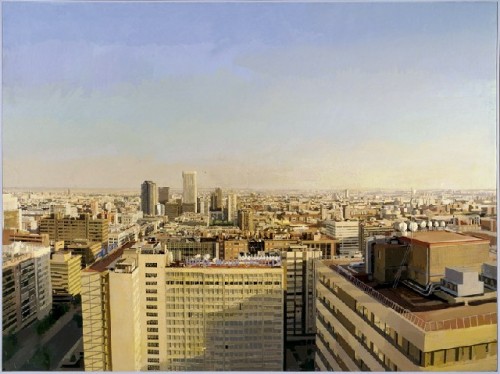
Because of the sparsity of dialogue, often the words spoken take on deep and cryptic meanings, bordering on philosophical: “I am among no-one”, “reality is arbitrary”, “the girl is a criss-cross”. The mystery deepens when the words seem to be reflected in what the protagonist sees at subsequent visits to the art gallery (Madrid’s Centro de Arte Reine Sofia), such as a girl’s figure in the shape of a cross. A personal exciting moment was when we get the protagonist’s point of view of the Madrid skyline, which then seamlessly transposes over the Antonio López painting, Madrid from Captain Haya, which he views. I instantly recognised this same piece from when it displayed last year at ACMI as part of the Kiarostami/Erice Correspondences exhibition.

The film is episodic, which we often find in Jarmusch’s films. Each episode involves a different character, in a different location, with different art production. I must say that the visuals are an absolute delight: colour composition and the use of the frame are awesome. There is nothing showy in Christopher Doyle’s stunning camera work, which uses an assortment of great angles, often static, and any movement used is masterful and restrained. The opening shot is, in fact, a very unconventional and skewed angle that takes a few seconds to work out what the protagonist is actually doing, and sets the tone of the film.

The film plays on patterns. There are visual patterns – some of the most arresting images you’ll see in a film – and there are narrative patterns, that repeat themselves and create an expectation in the audience. But each iteration is different from the previous and it’s satisfying to detect the subtle differences in each idiosyncratic repetition.

The film has an impressive support cast including Bill Murray, Tilda Swinton, Gael García Bernal, Hiam Abbass, John Hurt and others, but no-one is named. The credits merely describe them: Lone Man, Nude, Blonde, Guitar, etc.

** SPOILER ALERT **
I put the alert because you may want to discover for yourself without pre-empting: the film’s subtext is about the eternal struggle between those who love peace and art (including poetry, music, film, philosophy, etc) and the power-mongering politicians. That becomes evident as the story progresses and is cryptically underscored with the film's final message: "NO LIMITS. NO CONTROL."
** END ALERT **

The film is self-reflexive, an ironic (perhaps even comic) conceit that Jarmusch allows himself that recalls Wim Wenders’ The State of Things, in which Wenders’ stand-in, Patrick Buchau, talks about the use of black and white (in a black and white film). Similarly Jarmusch’s characters discuss techniques in film that he is demonstrating at that very point in the film. It’s a lot of fun.

Despite the familiarity, there’s something profoundly refreshing about Jarmusch’s films. It’s not just the visuals, it’s not just the wild characterisations that border on the comic, nor just the bizarre dialogue, nor the lack of exposition. Did I mention the fabulous sound design and music? Basically it’s all of the above, and how Jarmusch constructs the elements in a way that exceeds the sum of the parts. It makes this film fascinating. I have several Jarmusch films to catch up on, but of those I have seen, The Limits of Control is one of his very best and possibly the best cinema release of the year so far. It opens in cinemas today.

Monday, June 29, 2009

The Week in Review - 28/6/09

FILMS:
  • En construcción (Work in Progress, José Luis Guerín, Spain, 2001)
  • Innisfree (José Luis Guerín, Spain, 1990)
  • Bastardy +Q&A (Amiel Courtin-Wilson, Australia, 2008)
  • Le renard et l'enfant (The Fox and the Child, Luc Jacquet, France, 2007)
DVD:
  • T is for Teacher (Rohan Spong, Australia/USA, 2009)
SHORT FILMS:
  • MIAF - International Program #3
  • MIAF - Studio Watch: The Mill

Work in Progress
Quite a fascinating film whose documentation of the demolition of an old neighbourhood is reminiscent of the films of Pedro Costa (though without the same level of bleakness - not a criticism of either director's work). I don't have a lot to say about it other than, like In the City of Sylvia, Guerín demonstrates a photographer's fascination with capturing the soul of a city and its inhabitants.

Innisfree
Guerín's unconventional style is anything but mainstream. This is quite an odd film, an ode to the locations where John Ford shot The Quiet Man. Once again, Guerín is fascinated by location, this time rural Ireland. He certainly is an enigma.

Bastardy
Remarkably, Amiel Courtin-Wilson spent some seven or so years making this film, and in the Q&A session afterwards he explained why. Firstly, there was an issue with money, that came in dribs and drabs. The fact that the subject spent significant periods incarcerated also caused problems.

As I have mentioned previously, I met Jack Charles a few years ago and, having found him a very colourful and gregarious character, was keen to learn more about him. What a journey! As a 10 month old baby, he became a member of the Stolen Generation, and has never known his father. He discovered acting at age 19, set up the first Aboriginal theatre troupe in the 1960s, has been addicted to heroin since 1973, He's subsisted on burglary ("collecting the rent", he called it), has seen the walls of HM Pentridge up close and personal several times and has been homeless for large stretches of his life. There's more - much more - but that's it in a nutshell.

I found it fascinating that Jack sat in the front row (I was two rows directly behind him), with every conceivable shame on full display to him and the audience that filled the large Kino cinema. I was going to ask him during the Q&A how he felt about seeing himself like that, but he addressed it anyway. He said something to the effect that he was inspired to be able to set an example to his own people of what can be achieved, how he had left all this behind him and was now a respected elder of his mob. Since his last release from Deer Park prison, he's gone straight and says there's no going back to that life. I sincerely hope so.

[Pictured: John Safran, Jack Charles and Amiel Courtin-Wilson]

MIAF
From my perspective, animation shorts are a good interlude to serious film-going, which could be interpreted as some sort of snobbery, but that's what it is for me. I saw one of the international programs as well as a curated selection of shorts from The Mill, a London studio that has made many award-winning advertisements (some of which have appeared on Australian TV), music videos and short films. The Mill's work is very impressive and many of the pieces were not obviously animated, using animation to create hyper-reality to various situations.

T is for Teacher
I'm reviewing this ahead of the films screening at the Bayside Film Festival. I liked this a lot, and (with Rhys Graham's Skin) it's screening at 7pm on Thursday 16 July at Palace Brighton Bay, followed by a Q&A with director Rohan Spong. The film documents four transgender individuals as they transition from men to women in their roles as high school teachers in the US. My review is coming soon.

The Fox and the Child
This is a beautiful looking film that merges documentary with fiction. Basically, it takes a glorious rural landscape in France and contrives a little story - almost a fairy tale - about a young girl who befriends a wild fox. I would have preferred seeing the original French version, but the voice-over narration by Kate Winslet is quite OK and obviously makes it more marketable to an English-speaking audience. The story sometimes goes on a bit longer than necessary, but this is a very enjoyable film that is also well-suited for children.

Sunday, June 21, 2009

The Week in Review - 21/6/09

Winter solstice - I love it! There's a change in energy and from today the days start to get longer. The two-week Guerín season started at Melbourne Cinémathèque and, if you missed this week (a highlight of my year so far), make sure you see the coming screenings on Wednesday.

FILMS:
  • Wake in Fright (Ted Kotcheff, Australia/USA, 1971)
  • En la ciudad de Sylvia (In the City of Sylvia, José Luis Guerín, Spain, 2007)
  • Unas fotos en la ciudad de Sylvia (Some Photos in the City of Sylvia, José Luis Guerín, Spain, 2007)
  • Tren de sombras (Train of Shadows, José Luis Guerín, Spain, 1997)
  • Reservations (Aloura Melissa Charles, USA, 2008)
Wake in Fright + Q&A session
I don't have time to go into detail. I found this really enjoyable, a gutsy Australian film, made by a Canadian. Maybe it takes an outsider to take an honest look at ourselves, for that is what Kotcheff achieved. It's very authentic and has dated really well. It looks a helluva lot better than the pirated DVD copy of a VHS that screened at MUFF last year, but I was aghast when about a minute or two disappeared from the screening I attended. Grant wants to leave the pub when the cop (Chips Rafferty) is about to take him to task for not offering to shout a drink in return. We missed that, but the first-time audience wouldn't know it.

The Q&A was with director Ted Kotcheff, editor Anthony Buckley and moderated by Mark Hartley (Not Quite Hollywood). Various stories and anecdotes were shared and enhanced the evening. I raised the issue of the missing bits, but given that the speakers weren't in attendance during the screening, couldn't really comment. Buckley assured me that the film is present in its entirety, so I'm assuming it was a one-off glitch.

In the City of Sylvia
José Luis Guerín’s In the City of Sylvia has been described using various well-deserved superlatives. Not only is Guerin's unique film an amazing cinematic accomplishment, but it does it with almost no dialogue. It taps into primal human desires for connection and desire, exploring the nature of memory.

Humanity is a strange beast, full of contradictions. On the one hand, “man is gregarious” and we desire love, friendship, community and so on. On the other, there is an inherent incompatibility between both individuals and communities, who seemed destined for conflict. True friendship is, it appears, quite rare and many friendships seem to depend on absence for sustenance (a type of “absence makes the heart grow fonder”, I suppose).

The Melbourne Cinémathèque screening of In the City of Sylvia was greatly enhanced by Some Photos in the City of Sylvia which is much more compelling than it looks on paper. Not only is it completely silent (no dialogue, voiceover or music - which highlighted my rumbling belly and no doubt disturbed those sitting close to me), but there are no moving images either. It consists of a series of still photographs by Guerín that effectively constitute (unconventionally) a type of making-of documentary that explains the original film.

Not only is the original film highly autobiographical or self-reflexive, dramatising the director’s own experiences over twenty years earlier in the same locations, but it sheds light on his intentions with the film and the theme of the struggle between the human desire to connect and the natural resistance to the same, or disconnection.

The film has both a naturalistic look and feel, yet stylistically heightened. The visuals are stunning, with Strasbourg an amazing backdrop as our artist protagonist traverses the streets of this picturesque small city in search of his lost Sylvia. The film assumes a voyeuristic perspective, highly observational, perhaps as the guy sees the city. We see lots of images of women, particularly young women. Some are gorgeous, some not. Often they are backdropped by large perfume advertisements that feature the faces of gorgeous young models, underscoring the director’s fascination with femininity.

Guerín’s preoccupation with faces takes various forms and he often portrays how people appear from the voyeur’s perspective. He could almost be toying with the audience, demonstrating how from a distance one person looks relative to another: they are not seated together but from the viewer’s perspective appear to relate. Deep focus is used to good effect, differentiating between the different scenarios. Similarly, Guerín seems fascinated by the dual or parallel imagery of filming someone through a window whose reflections superimpose over the person, creating a unique kind of visual experience.

Couples kissing are a recurring theme. Several characters reappear intermittently, like the African belt seller. A homeless woman is sitting in the street and, while we don’t see her again, we recognise her discarded beer bottles. “LAURE JE T’AIME” appears to be scrawled all around the city. Who is this Laure? And who is her lover?

In a film where dialogue is near absent, the music takes on a heightened sense of importance. It powerfully punctuates the narrative in an organic manner as our protagonists wander the steets. Sometimes there are performers at the conservatoire, buskers in the street or music blaring over speakers in a bar or passing car.

In the City of Sylvia is poetic, original, beautiful, captivating and moving. It is an experience and a privilege. If you get the chance to see it, don’t miss it.

Tren de sombras
Fatigue set in during this screening and I don't think I imbibed it as well as I could have otherwise. So I don't want to comment on it, other than to say I'd like to see it again.

Reservations
Nice film, but unexceptional. Co-presented by ACMI and Women in Film and Television, it naturally has a woman director and features Australia's Kerry Armstrong in top billing in an ensemble piece. Like In the City of Sylvia, it deals with themes of human disconnection as we encounter various lonely individuals spending one night in the same New York hotel.

Reservations is what I find myself now calling a "worthy" film, and that's not a compliment. Like many local films of recent years that tackle "worthy" issues, it somehow lacks dramatic impact. Sure, a film doesn't have to be hyper-real, but it just lacks pizzazz, oomph, mojo, something. We can see where it's going, it seems a bit too derivative and the film's conclusion is a bit too neat. But it's worthy!

Sunday, May 24, 2009

The Week in Review - 24/05/09

FILMS:
  • Chicago (Frank Urson, USA, 1927)
  • Thunderbolt (Josef von Sternberg, USA, 1929)
  • El ángel exterminador (The Exterminating Angel, Luis Buñuel, Mexico, 1962)
I don't have time right now to write about these, but am happy to discuss. Any thoughts?

Sunday, May 17, 2009

The Week in Review - 17/5/09

FILMS:
  • Zabriskie Point (Michelangelo Antonioni, USA, 1970)
  • Der Stand der Dinge (The State of Things, Wim Wenders, West Germany/Portugal/USA, 1982)
  • Samson and Delilah (Warwick Thornton, Australia, 2009)
  • Rudi y Cursi (Rudi and Cursi, Carlos Cuarón, Mexico/USA, 2008)
  • Sita Sings the Blues (Nina Paley, USA, 2008)
SHORT FILMS:

Zabriskie Point

Wow! After the disappointment that was The Passenger, this was surprisingly good. Antonioni wears his political leanings on his sleeve (something I'm prone to myself) and really captures the zeitgeist. Sometimes a film is too close to the bone; this film seems to be have been too confrontational for American audiences at the time of its release. Often a film can be appreciated for what it captures long after the emotions of the time have dissipated. This is certainly true of many Australian films that were not acknowledged on first release, such as some of the so-called Ozploitation films or Pure Shit, which (like Zabriskie Point) has elements that are almost documentary-like now.

The lack of expository narrative in Zabriskie Point really adds to its mystique. Antonioni's camera gradually covers various, seemingly unconnected scenarios and we, the audience, have to work a little to make sense of it. Or, not so much make sense as try to connect the dots. By covering a student meeting calling for revolt, police brutality, riots and capitalism in action, it's not too hard to see where Antonioni is going.

The film has an unmistakable 70's feel to it, though it was made at the start of the decade. The themes are clearly related to the aftermath of the political turbulence that swept the globe in 1968, most strongly recalling Haskell Wexler's Medium Cool (1969). The final explosion, while literally a blast, is not the film's biggest drawcard for me, though clearly a delight for the film's fans.

The State of Things
There's been a lot of films made about making films. For me, this one directly recalls Catherine Breillat's Sex is Comedy. Both films are about the struggles of making the respective director's previous trouble-prone film. The self-reflexive nature of this Wenders film is quite funny, especially when the film is shot on black and white film and the script has a producer slamming the use of just that. There are a number of moments like that. I don't think the film is brilliant, but certainly very enjoyable.

Rudi and Cursi
After the very sublime Y tu mamá también (my favourite Mexican film), directed by Alfonso Cuarón and starring Gael García Bernal and Diego Luna, I figured a comedy by Alfonso's brother with the same duo of actors couldn't be too bad. Alas, it came in at the low end of my expectations.

It screened as part of the Spanish Film Festival at the Kino. I'm not accustomed to full-houses at the Kino, so I was pleased for their sake to see them doing good business. Rudi and Cursi is really a populist film and I suppose it certainly got bums on seats. I just found it all a bit tiresome. Here's two very luminous and intelligent actors (Luna played the Michael Jackson look-alike in Mister Lonely), and it was obviously some kind of joke to have them playing dumbass country hicks who hit the big-time when they're scouted for rival Mexico City football clubs.

Don't get me wrong, I don't have a problem with intelligent actors playing dumbasses; that's what actors do. But the gags were all fairly puerile and predictable. The film did nothing for me whatsoever.

Sita Sings the Blues
I'm more than familiar with the Ramayana, having spent some part of my youth exploring Hinduism and Indian culture - I've been there six times. I'd heard good things about this film, especially from Lynden Barber of Eyes Wired Open, so took the opportunity to take my eight-year old son to see it. The Ramayana recounts the story of Rama, an incarnation of Vishnu (God), and his consort Sita who is abducted by Ravana and taken to Lanka. The monkey-king Hanuman finds Sita who is rescued by Rama but ultimately banished to the forest over doubts of her purity.

The film is visually stunning, with Sita singing love songs that are actually 1920's jazz songs by Annette Hanshaw. And cleverly, director Nina Paley weaves her own real-life heartbreak story into a parallel narrative. What most are not aware of is that Star Wars is almost a direct rip-off of the Ramayana. I don't think as highly of the film as Lynden obviously does, but it is entertaining and original nonetheless. And the kid's verdict? Like me, he liked it, but nothing special.

Monday, May 04, 2009

Spanish Film Festival 2009

Spanish cinema is not without its flaws, but it has a very definite cultural flavour that I appreciate. It doesn't shy away from politics or transgression. As just posted, the Spanish Film Festival opens next week. I'm going to be lazy and just cut and paste the promotional material:
The 2009 Spanish Film Festival opens 7pm Wednesday 13th May at Palace Cinema Como.

Join us for the Melbourne Premiere of CHEF’S SPECIAL, the hugely entertaining new comedy starring festival guest Javier Cámara (Talk To Her) as a headstrong Madrid chef whose life is turned upside down by the arrival of his son and a new love interest. The screening will be followed by a Spanish fiesta featuring Spanish wine, beer and live latin/salsa/funk entertainment to dance away to from the OJ Project (featuring Oscar Jimenez and members of Watussi) – it will be a night to remember!

The Opening Night event headlines a fantastic 12 day festival that features over twenty five Melbourne premieres screening May 13-24 at Palace Cinema Como & Kino Cinemas.

Festival highlights include:
• The lively new comedy RUDO & CURSI (M) that reunites the stars of Y Tu Mamá También, Gael Garcia Bernal & Diego Luna;
• The audacious new comedy THE SHAME direct from the 2009 Malaga Film Festival;
• Lena Burke in the feel-great new comedy LA MALA which features a hit salsa & bolero soundtrack;
• Augustín Díaz Yanes’ spectacular new thriller JUST WALKING featuring an all-star cast including Victoria Abril & Diego Luna;
• The fascinating new doco A WAR IN HOLLYWOOD about the US film industry’s depiction of the Spanish Civil War;
• The witty new Cuban comedy HORN OF PLENTY from director Juan Carlos Tabio (Strawberry & Chocolate);
• The heart-warming new documentary OLD MAN BEBO about octogenarian pianist and Mambo pioneer Bebo Valdes;
• A TRIBUTE TO LUIS BUNUEL retrospective
• and many more!

Plus special events:
• Q&A with Javier Cámara following the gripping new Civil War drama BLIND SUNFLOWERS 6.30pm Thu 14 May at Palace Cinema Como;
• Introduction by Javier Cámara before his hit film TALK TO HER, 9.15pm Thu 14 May at Palace Cinema Como
• Closing Night “Salsateca” – the Cuban comedy HORN OF PLENTY will be followed by drinks, music & Salsa DJ! 7.15pm Sun 24 May at Palace Cinema Como.

FESTIVAL DETAILS
Dates: May 13-24
Venues: Palace Cinema Como (Corner Toorak Road and Chapel Street South Yarra), Kino Cinemas (45 Collins St, Melbourne).
Tickets: Opening Night: $40 / Closing Night “Salasteca”: $25.00
General Sessions: Adult $16.00, Movie Club $13.50, Children $10 (check film classification)
5 Film Pass: $70 (not available online)

HURRY - TICKETS NOW ON SALE!
• At the cinemas in person 12.00-8.30pm daily
• By calling Palace Cinema Como on 9827 7533 or Kino Cinemas on 9650 2100. (Please note cinema box offices only sell tickets for their respective venues)
• Online 24hrs http://www.palacecinemas.com.au

Sunday, May 03, 2009

The Week in Review - 3/5/09

In preparation for the Spanish Film Festival (13 - 24 May), which features a Luis Buñuel retrospective and exhibiton, not only have I been watching a number of Buñuel's films on DVD, but two of the three films I saw on the big screen seem to have been inspired by his surrealist film-making. There's a number of films I want to see at the Spanish Film Festival, but the Buñuel retrospective particularly interests me. I've also been asked to contribute to the festival blog. Unlike the German Film Festival, whose blog was contributed by two writers conversant with German cinema, the SFF bloggers are basically local bloggers who are discovering Spanish cinema through the festival. I'll have more to say about this soon.

The Malle season at Melbourne Cinémathèque has now come to an end. The highlights for me were Lancombe, Lucien, Le feu follet and Au revoir, les enfants. Ascenseur pour l'échafaud was also quite impressive, especially as a first film. I love the way these short seasons/mini-retrospectives give a taste for a director's work. Louis Malle made over 30 films, so now I've got a taste to explore some of the others - any suggestions appreciated.

FILM:
  • Synecdoche, New York (Charlie Kaufman, USA, 2008)
  • Au revoir, les enfants (Goodbye, Children, Louis Malle, France/West Germany, 1987)
  • Zazie dans le métro (Zazie in the Metro, Louis Malle, France/Italy, 1960)
DVD:
  • Le journal d’une femme de chambre (Diary of a Chambermaid, Luis Buñuel, France/Italy, 1964)
  • Belle de jour (Luis Buñuel, France/Italy, 1967)
  • Le charme discret de la bourgeoisie (The Discrete Charm of the Bourgeoisie, Luis Buñuel, France/Italy/Spain, 1972)
  • Le fantôme de la liberté (The Phantom of Liberty, Luis Buñuel, France/Italy, 1974)

Synecdoche, New York
Synecdoche, New York was originally going to be directed by Spike Jonze but by the time Charlie Kaufman had the script ready, Jonze was tied up with Where the Wild Things Are, and Jonze agreed to Kaufman's directing it.

There's a similar style to the earlier films written by Kaufman, which is hardly surprising as he has such an idiosyncratic style. But the themes and story are quite different. This film is really about a man's unhappiness within himself and wanting to achieve something both personally and professionally. Thematically, it's quite bleak, not that different to Le feu follet, but with Kaufman's clever and playful devices, it never feels down. He has a way of conveying some emotional truths in a way that people may not otherwise be receptive to them. I suppose you could say similar of Eternal Sunshine of the Spotless Mind.

There's a lot to admire in the film, including some lovely performances all round, and it really takes repeat viewings to absorb all the layers of details. The characters in the film seem to inhabit a Buñuelian universe, though instead of a person dreaming about a person dreaming about something absurd, Philip Seymour Hoffman's Caden Cotard is a director whose masterpiece is a self-reflexive piece of cinema in which characters play versions of himself and those in his life, which becomes convoluted to the point of the absurd.

The film has been described as experimental, but I don't agree. I think Kaufman is very much in command of what he does; it's just that he has a very surreal/fantasy/absurdist way of telling a story. There's not a lot of directors that have successfuly worked in this realm: Luis Buñuel as already mention, Raúl Ruiz and David Lynch are names that come to mind.

The narrative of the film is probably more ambitious than anything we've seen with Kaufman's name, and quite frankly, I think his lack of directorial experience is a factor in it not working quite as successfully as it might have been had Jonze been attached. Mind you, as a first film, it's quite an amazing achievement and the ambitiousness of the project is awesome. There's a real shortage of unconventional films that celebrate the power of imagination so overtly, so I think it deserves credit for taking the risks it does.

Synecdoche, New York opens this Thursday 7 May exclusively at the Nova.

Au revoir, les enfants
Au revoir, les enfants is sometimes described as Malle's masterpiece, which I think is a fair call. It certainly is a great companion piece to Malle's earlier Lancombe, Lucien and, given its strong autobiographical element, is both poignant and sheds further context to the earlier film.

I love the way that the film documents a way of life that simultaneously is dated yet universal. The depiction of life in a provincial Catholic boarding school is full of authenticity and seems almost documentary-like. Hopefully, there's not too many children growing up today in such conditions. The universality of it is the cruelty of children towards each other and reminds me of the bastardisation I experienced in my youth.

I particularly identify with Holocaust stories because I no doubt lost many distant relatives in that tragic episode of human history. In fact, my great-great grandfather left Russia in the 1800's and emigrated to then-Palestine, presumably escaping the bloody pogroms of the day. His three sons migrated to Melbourne in the 1880's and were prominent members of the Russian-Jewish community that clustered in Carlton. I still remember my great-grandmother's two-storey Victorian terrace on Swanston St, now long-demolished.

My only involvement in Jewish life during my adulthood has been to attend weddings and funerals. I rejected Judiasm in my teens (right after my barmitzvah, in fact, but that's another story, involving a nasty Polish rabbi), but I also rejected all religions. But that was then. I now respect all religions and all cultures, and part of that has been to accept and honour my own cultural roots. So I embrace my Jewishness, even though I don't consider myself Jewish per se.

Back to the film, I can't watch a film like Au revoir, les enfants without feeling a connection to those who suffered. To single out people based on one arbitrary fact is just barbaric, just like the so-called ethnic-cleansing of so many nations since. Growing up in the shadow of World War II, there was a sense that "this must never happen again", yet how wrong have we been? Rwanda, Bosnia, Kosovo, the Kurds... the list goes on.

The story in this film, from the perspective of the child, is powerful enough. But the ending is just shattering, how Malle describes how the moments of the film's ending have haunted him for the past forty years. The film joins a number of powerful post-war films that also depict the war from a child's perspective: Malle's Lancombe, Lucien, Tarkovsky's Ivan's Childhood, Klimov's amazing Come and See, and others. Malle's film also recalls Andrzej Wajda's Katyn in that it is a strongly autobiographical account of the war.

Zazie in the Metro
The Senses of Cinema annotations for this film certainly helped me to appreciate this film from a deeper perspective that I otherwise would have. And having seen the first two of Malle's films during this Melbourne Cinémathèque season, it was great to see the third. But it still did little for me. Sure, it was nice to see the urban decay of Paris, and I found it interesting to see similarities with Buñuel in terms of absurdity, but it still seemed a bit too steeped in slapstick to be a serious critique of contemporary social and political norms. For me, it's worth seeing only in the context of the varied body of Malle's work.