Jim Jarmusch is quite simply one of the most interesting living film-makers working out of the USA. His latest film, The Limits of Control, is set in Spain with an international cast. There is at the core of his work a consistency of style and yet this latest outing represents a progression in the evolution of his body of work that is simultaneously understated and visually spectacular. One is never in any doubt that one is watching a Jarmusch film.
The Limits of Control is at least superficially a mystery. Designed like a Hitchcock spy thriller and oozing with a retro 70’s style that remains distinctly contemporary, characters behave like something out of an early James Bond movie or even Get Smart. There are secret passwords and the passing of small coded messages that are then swallowed. Knowing words are spoken cryptically: “Wait three days for the bread; the guitar will find you”. Despite sounding corny, it’s actually full of panache, though dark humour is (unsurprisingly) never far away. There’s also an element of film noir, including creative depictions of nudity.
The film is sparse with dialogue and characters speak languages different to each other. Sound familiar? It should. Language, communication and miscommunication seem to be recurring themes for Jarmusch. The very photogenic Isaach De Bankolé takes centre stage in the film and it is hard not to recall the scenario between his earlier character in Jarmusch’s Ghost Dog, a French ice-cream van vendor in New York, speaking not a word of English yet maintaining a friendship with the non-French speaking title character (Forest Whitaker).
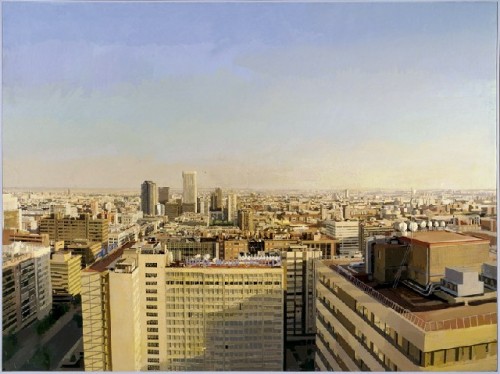
Because of the sparsity of dialogue, often the words spoken take on deep and cryptic meanings, bordering on philosophical: “I am among no-one”, “reality is arbitrary”, “the girl is a criss-cross”. The mystery deepens when the words seem to be reflected in what the protagonist sees at subsequent visits to the art gallery (Madrid’s Centro de Arte Reine Sofia), such as a girl’s figure in the shape of a cross. A personal exciting moment was when we get the protagonist’s point of view of the Madrid skyline, which then seamlessly transposes over the Antonio López painting, Madrid from Captain Haya, which he views. I instantly recognised this same piece from when it displayed last year at ACMI as part of the Kiarostami/Erice Correspondences exhibition.
The film is episodic, which we often find in Jarmusch’s films. Each episode involves a different character, in a different location, with different art production. I must say that the visuals are an absolute delight: colour composition and the use of the frame are awesome. There is nothing showy in Christopher Doyle’s stunning camera work, which uses an assortment of great angles, often static, and any movement used is masterful and restrained. The opening shot is, in fact, a very unconventional and skewed angle that takes a few seconds to work out what the protagonist is actually doing, and sets the tone of the film.
The film plays on patterns. There are visual patterns – some of the most arresting images you’ll see in a film – and there are narrative patterns, that repeat themselves and create an expectation in the audience. But each iteration is different from the previous and it’s satisfying to detect the subtle differences in each idiosyncratic repetition.
The film has an impressive support cast including Bill Murray, Tilda Swinton, Gael García Bernal, Hiam Abbass, John Hurt and others, but no-one is named. The credits merely describe them: Lone Man, Nude, Blonde, Guitar, etc.
** SPOILER ALERT **
I put the alert because you may want to discover for yourself without pre-empting: the film’s subtext is about the eternal struggle between those who love peace and art (including poetry, music, film, philosophy, etc) and the power-mongering politicians. That becomes evident as the story progresses and is cryptically underscored with the film's final message: "NO LIMITS. NO CONTROL."
** END ALERT **
The film is self-reflexive, an ironic (perhaps even comic) conceit that Jarmusch allows himself that recalls Wim Wenders’ The State of Things, in which Wenders’ stand-in, Patrick Buchau, talks about the use of black and white (in a black and white film). Similarly Jarmusch’s characters discuss techniques in film that he is demonstrating at that very point in the film. It’s a lot of fun.
Despite the familiarity, there’s something profoundly refreshing about Jarmusch’s films. It’s not just the visuals, it’s not just the wild characterisations that border on the comic, nor just the bizarre dialogue, nor the lack of exposition. Did I mention the fabulous sound design and music? Basically it’s all of the above, and how Jarmusch constructs the elements in a way that exceeds the sum of the parts. It makes this film fascinating. I have several Jarmusch films to catch up on, but of those I have seen, The Limits of Control is one of his very best and possibly the best cinema release of the year so far. It opens in cinemas today.