Showing posts with label nudity. Show all posts

Thursday, July 23, 2009

The Limits of Control

The Limits of Control (Jim Jarmusch, Spain/USA/Japan, 2009)
Jim Jarmusch is quite simply one of the most interesting living film-makers working out of the USA. His latest film, The Limits of Control, is set in Spain with an international cast. There is at the core of his work a consistency of style and yet this latest outing represents a progression in the evolution of his body of work that is simultaneously understated and visually spectacular. One is never in any doubt that one is watching a Jarmusch film.

The Limits of Control is at least superficially a mystery. Designed like a Hitchcock spy thriller and oozing with a retro 70’s style that remains distinctly contemporary, characters behave like something out of an early James Bond movie or even Get Smart. There are secret passwords and the passing of small coded messages that are then swallowed. Knowing words are spoken cryptically: “Wait three days for the bread; the guitar will find you”. Despite sounding corny, it’s actually full of panache, though dark humour is (unsurprisingly) never far away. There’s also an element of film noir, including creative depictions of nudity.

The film is sparse with dialogue and characters speak languages different to each other. Sound familiar? It should. Language, communication and miscommunication seem to be recurring themes for Jarmusch. The very photogenic Isaach De Bankolé takes centre stage in the film and it is hard not to recall the scenario between his earlier character in Jarmusch’s Ghost Dog, a French ice-cream van vendor in New York, speaking not a word of English yet maintaining a friendship with the non-French speaking title character (Forest Whitaker).

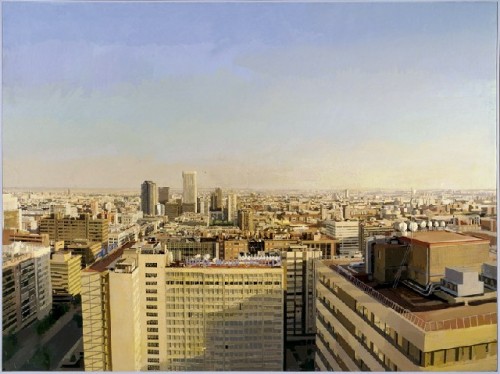
Because of the sparsity of dialogue, often the words spoken take on deep and cryptic meanings, bordering on philosophical: “I am among no-one”, “reality is arbitrary”, “the girl is a criss-cross”. The mystery deepens when the words seem to be reflected in what the protagonist sees at subsequent visits to the art gallery (Madrid’s Centro de Arte Reine Sofia), such as a girl’s figure in the shape of a cross. A personal exciting moment was when we get the protagonist’s point of view of the Madrid skyline, which then seamlessly transposes over the Antonio López painting, Madrid from Captain Haya, which he views. I instantly recognised this same piece from when it displayed last year at ACMI as part of the Kiarostami/Erice Correspondences exhibition.

The film is episodic, which we often find in Jarmusch’s films. Each episode involves a different character, in a different location, with different art production. I must say that the visuals are an absolute delight: colour composition and the use of the frame are awesome. There is nothing showy in Christopher Doyle’s stunning camera work, which uses an assortment of great angles, often static, and any movement used is masterful and restrained. The opening shot is, in fact, a very unconventional and skewed angle that takes a few seconds to work out what the protagonist is actually doing, and sets the tone of the film.

The film plays on patterns. There are visual patterns – some of the most arresting images you’ll see in a film – and there are narrative patterns, that repeat themselves and create an expectation in the audience. But each iteration is different from the previous and it’s satisfying to detect the subtle differences in each idiosyncratic repetition.

The film has an impressive support cast including Bill Murray, Tilda Swinton, Gael García Bernal, Hiam Abbass, John Hurt and others, but no-one is named. The credits merely describe them: Lone Man, Nude, Blonde, Guitar, etc.

** SPOILER ALERT **
I put the alert because you may want to discover for yourself without pre-empting: the film’s subtext is about the eternal struggle between those who love peace and art (including poetry, music, film, philosophy, etc) and the power-mongering politicians. That becomes evident as the story progresses and is cryptically underscored with the film's final message: "NO LIMITS. NO CONTROL."
** END ALERT **

The film is self-reflexive, an ironic (perhaps even comic) conceit that Jarmusch allows himself that recalls Wim Wenders’ The State of Things, in which Wenders’ stand-in, Patrick Buchau, talks about the use of black and white (in a black and white film). Similarly Jarmusch’s characters discuss techniques in film that he is demonstrating at that very point in the film. It’s a lot of fun.

Despite the familiarity, there’s something profoundly refreshing about Jarmusch’s films. It’s not just the visuals, it’s not just the wild characterisations that border on the comic, nor just the bizarre dialogue, nor the lack of exposition. Did I mention the fabulous sound design and music? Basically it’s all of the above, and how Jarmusch constructs the elements in a way that exceeds the sum of the parts. It makes this film fascinating. I have several Jarmusch films to catch up on, but of those I have seen, The Limits of Control is one of his very best and possibly the best cinema release of the year so far. It opens in cinemas today.

Tuesday, October 21, 2008

Choke

Choke (Clark Gregg, USA, 2008)
Choke is actor Clark Gregg's writer-directorial debut, with a screen adaptation of a novel by Chuck Palahniuk (Fight Club). I suspect that connection will draw many people to see Choke, but really they're very different films. First, Clark Gregg is not David Fincher, secondly this is a very different story.

Apparently, the story is semi-autobiographical, but I don't intend to go into the details of what parts are autobiographical, which are metaphorical, and which represent the experiences of those close to Palahniuk. I don't find it particularly relevant, but if you're interested, you can Google that yourself (or check out this article in The Age).

There's a lot happening in Choke, and the film attempts to get around this by depending too heavily on Rockwell's voiceover narration. It might have worked well with Edward Norton in Fight Club, but seems both a bit heavy-handed here and it detracts from the coherence. What the... ? The whole point of narration is to improve coherence, a shortcut alternative to depicting everything on-screen by relaying a character's thoughts.

I found the film a little disappointing. It looks good, it sounds good, the acting is good (Sam Rockwell is always good value, and the rest of the cast is also fine). The story is quirky, and to some, that could be code for where the film doesn't work.

The quirkiness factor comes in right from the start with just too many competing themes that feel forced (à la Little Miss Sunshine). There's the sex-addiction, and the attendance at group therapy sessions (a good place to get laid, apparently). Then there's the heritage theme park where Rockwell's character, Victor, plays a part alongside his best pal, Denny (a charismatic Brad William Henke), also a sex addict. There's the ruse Victor pulls in restaurants, pretending to choke, in order to get the sympathy of strangers. There's the descent into dementia by Victor's mother (Anjelica Huston), who may hold the key to some mysteries about Victor's identity. And there's the complexity that Paige Marshall (well-acted by Kelly Macdonald) brings in the form of a potential love interest.

On the surface, that's a lot of ground to cover, and Gregg does a not too bad job as first-time director. I'm sure a lot of people will find this film a lot more enjoyable than I did; the success of films like Juno and Little Miss Sunshine is testament to that. For me, there were many elements that in isolation may have been good, but didn't come together successfully as a whole. The editing of the film may be at least partially to blame, but ultimately, Gregg has been a little too ambitious and hasn't quite succeeded in sewing all the bits together as well as he intended. There's a twist at the end that I found a little weak and conventional, but I'm not giving that away. To the film's credit - and you'd expect this from a Palahniuk story - it's unconventional.

Choke opens on October 30.

Thursday, October 25, 2007

ACMI Focus on Catherine Breillat

Catherine Breillat stands out, not just as a female auteur, but one who embraces challenging material. Her films are mostly explorations of female relationships, stories that depict the transformative and transgressive nature of sexuality. Some find her films obscene, while Breillat herself questions the meaning of obscenity.

À ma souer! (For My Sister, 2001) is a gritty family story about two sisters. Anatomie de l’enfer (Anatomy of Hell, 2004) was particularly challenging for audiences with its depictions of female perversity. Romance (1999) was originally banned in this country, but received an R rating upon appeal. It’s a mystery, then, why her latest film, Une vieille maîtresse (An Old Mistress) has received an R-rating, as it bears little in common with her earlier works.

An Old Mistress apparently marks a new point in Breillat’s career. She claims to be leaving the coming-of-age stories and sexual explorations of her earlier films behind her. Her latest film is a lavish period piece (set in 1835, and based on a novel of the same name by Jules-Amédée Barbey d'Aurevilly [1808-1889]) whose budget was greater than her previous ten films combined. Says Breillat:

All my previous films were judged nefarious or scandalous, but they did not represent the real me. I think this film really corresponds to my personality. I'm free at last. It represents the me that does not rise up against the world and its taboos. When I'm at peace, I'm actually terribly romantic.

Ryno de Marigny (Fu'ad Ait Aattou) is a notorious womaniser who has had a torrid relationship with Vellini (Asia Argento) a woman of dubious morals herself. Ryno visits Vellini to tell her their relationship is over and that he truly loves another woman, Hermangarde (Roxane Mesquida). The Mistress in the title is Hermangarde’s grandmother and guardian, the Marquise de Flers (Claude Sarraute), the woman to whom Ryno must convince of his genuine love for her charge. The film's story unfolds as he frankly divulges the details of his affair with Vellini to the Marquise.

In many respects, this is a fairly conventional period story though, as I have mentioned in previous posts, the French seem much more capable of working in this genre than their English counterparts. While the English get bogged down in staid caricatures and theatrics, the French are able to breathe life into their characters with a much greater sense of naturalness and a fluidity of narrative that more readily engages an audience. I found this with Patrice Chéreau’s Queen Margot (1994), Pascale Ferran’s recent Lady Chatterley and it’s certainly true with Breillat’s An Old Mistress, in which she has assembled a fine cast that both look good and play their parts most competently.

Not unsurprisingly (for Breillat), the film depicts some nudity and sexuality, but, it’s quite passé, hardly any more risqué than Pascale Ferran’s recent Lady Chatterley, which received an M-rating. Maybe the censors (because that’s what the OFLC are) automatically assume a Breillat film is going to offend. This is unfortunate, because this is a beautiful and inoffensive film that should get the exposure that an M or MA rating would allow. The sex and nudity is a very minor aspect of the film.

Part of my respect for Breillat’s films are their ability to challenge my own sensibilities. I find it perverse that a film’s depiction of graphic sex or nudity should cause such moral outrage when violence is both ubiquitous and considered entertaining. And when one looks at a film like Tarantino’s hugely violent Death Proof (due for release on 1 November) with an MA-rating, one wonders about the consistency of the OFLC.

An Old Mistress will probably attract fans of Breillat’s films, and I’m intrigued to know what they think of it. I liked it a lot, though I prefer the grittiness of her more social-realist films. The film will also appeal to an audience that may have previously avoided her work. It is definitely a more accessible film, that will likely appeal to those who liked Lady Chatterley, yet it still has that little extra edge.

Personally, I’m very much looking forward to ACMI’s Focus on Catherine Breillat, which opens tonight with the premiere of An Old Mistress. I’m particularly looking forward to seeing Romance, which I missed when it was released in 1999, as well as other titles such as Brève traverse (Brief Crossing, 2001), Sex is Comedy (2002), Sale comme un ange (Dirty Like an Angel, 1991), Tapage nocturne (Nocturnal Uproar, 1979) and 36 fillette (1987).

ACMI’s Focus on Catherine Breillat opens today and ends on 4 November. The screening dates are also in my Calendar of Film Events (in the sidebar).

Links: Interview re: À ma souer / Interview re: Anatomy of Hell / Senses of Cinema

Photo: Fu'ad Ait Aattou as Ryno de Marigny and Asia Argento as Vellini in An Old Mistress

Friday, June 29, 2007

The Double Life of Veronique

La double vie de Véronique (The Double Life of Veronique, Krzysztof Kieslowski, 1991)
[This post contains spoilers]

Watching a film like Krzysztof Kieslowski’s The Double Life of Veronique on the wide screen at the Astor Theatre is truly one of life’s great joys, and one of the reasons I keep going back into darkened cinemas for more. There are many types of films one can like a helluva lot, but films like this embody what is most important to me about the medium.

Kieslowski doesn’t use a great number of words to convey a narrative. With sparse dialogue, magnificent visuals, sound and music, he puts together a story – full of ambiguity and uncertainty, allowing our imagination or personal projections to fill in the gaps. His work could be considered spiritual, metaphysical, existential, political, romantic or atheistic depending on the outlook of the viewer. There’s possibly a little of each of these sprinkled throughout his work, but primarily what I find in abundance is a deep sense of humanity.

Watching The Double Life as a part of the body of Kieslowski’s films that I’ve seen thus far, it seems abundantly clear to me that there is a common thread of deep humanism. Whether it is his patiently capturing the words and body language of humble workers or hospital patients in his early documentaries or depicting more morally intricate and stylistic scenarios, there is a sense that this is a film-maker who understands the complex nature of human beings, their drives, their struggles and their suffering. If I had to pick one common theme in his work, it is this: the human race is connected through the common experience of struggle.

[Spoilers follow]

Connectedness is a theme that comes to the fore in The Double Life in a most sublime, subtle, poetic and evocative manner. Two girls, born at around the same time, in different places, they look the same and follow a similar life path. Not only are they practically twins, they are almost the same person. Intuitively aware of the unknown and unseen existence of the other, they feel unalone in the world. When woe befalls one, the other feels the loss and grieves for something or someone she knows not.

This is not an original theme – the Superman comics of my teens spoke of everyone in the world having an alter ego, an identical double somewhere. Kieslowski raises this comical idea to a transcendent and haunting design that draws one into its exploration of a fantastical and emotionally wrenching reality. Woven throughout the narrative is the recurring Kieslowski theme of chance or destiny. One catches a glimpse of the other, but they do not meet.

Irène Jacob plays both Veronique and Veronika. There are devices that reappear in the Three Colours trilogy, particularly Red, in which Jacob played the main character. There is the old woman, who in the trilogy is attempting to place a bottle in the bin. In The Double Life we see a similar character (twice) but in a slightly different situation. Jacob’s characters respond with genuine concern for the women’s welfare.

Politics often plays a part in Kieslowski’s films, sometimes subtly (as in his early documentaries) or overtly (as in Blind Chance). One of the most critical moments in The Double Life takes place with a political protest as the backdrop, with running youth and lines of riot police. No explanation of the event is given.

Nor is the significance of the flasher ever made clear. It seems that Kieslowski is inserting details from life (perhaps things he has seen or read about) at unexpected moments – just like life itself. Some of them – like the flasher – seem to have no significance other than that of the moment. It serves to add understated drama, humour and surprise in an already rich story. Expect the unexpected. Other details appear that are not explained: the dour-faced woman from the Polish audition passes momentarily at the train station (another recurring device). We see her expression, but hear not a word from her. We can only imagine what she must be thinking.

A poignant moment in the film occurred when Alexandre (the puppeteer, played by Philippe Volter) explained why there were two dolls (metaphorically, two Véroniques). They damage easily, he says, so one is needed as a backup. I don’t think this was intended literally in relation to Véronique, but rather as a cryptic metaphor.

Part of the beauty of the film is that the performances are so natural. It all looks so effortless and the film flows fluidly. The characters are all so interesting, even the small fleeting roles like the orchestra conductor, the fathers of both women and the bent old woman are captivating.

The Double Life immediately preceded the Three Colours trilogy, and is very similar to the trilogy both thematically and stylistically. These four films could almost be a Four Colours quadrilogy, the colour of The Double Life being yellow (though the colour green is more noticeable as a secondary colour on the DVD version than on the big screen). The use of a colour theme in this film seemed to be stronger than the use of any colour of the trilogy, and was reminiscent of the production design of Darren Aronofsky’s The Fountain (perhaps Aronofsky took some inspiration from this film).

It seems that Kieslowski was developing themes and ideas that he further built on over subsequent films. Just like David Lynch’s Twin Peaks seems like a further development of ideas expressed in Blue Velvet. Music was cleverly integrated into the narrative in both The Double Life and Kieslowski’s subsequent film Blue. Its presence was overt and sumptuous, but never anything but a natural element of the production. Composer Zbigniew Preisner’s many collaborations with Kieslowski included The Double Life and the entire trilogy.

All four of these films were also co-written by Krzysztof Piesiewicz and all but White were edited by Jacques Witta. A common aesthetic in these films can be at least partially attributed to a consistent creative team. Three Colours: Blue remains my favourite Kieslowski film, and close to my all-time favourite film. The Double Life of Véronique is not far behind; I consider it on a par with the rest of the trilogy.

The Double Life of Véronique is a film that is hard to categorise: it could be considered a mystery, drama or a thriller. It is erotic, existential and metaphysical. It’s an important work by an important film-maker with timeless appeal. It was great to see it on the Astor’s large screen and I look forward to discovering more of Kieslowski’s work.

Tuesday, June 19, 2007

Ma mère

Ma mère (My Mother, Christophe Honoré, 2004)
There are shocking things depicted in Ma mère – things a human being should never be subjected to. A parent’s role is to protect, nurture, empower and instil a sense of responsibility in his or her child. What if a parent subjects his or her child to the very worst type of activities that responsible parents aspire to protect their children from? That’s the exploration of this film, loosely adapted from an unfinished novel by Georges Bataille.

I sometimes find a number of challenges when writing about serious films like Christophe Honoré’s Ma mère. The film is itself challenging to audiences, of a level similar to Ôdishon (Audition, Takashe Miikie, 1999) or Gaspar Noé’s Irréversible, though this film is without the violent horror of those films. A theme of transgression is similar to The King (James Marsh, 2005), but is much more graphic and confronting than Marsh’s excellent film. It goes beyond transgression to calculated moral corruption of the innocent.

I’d go so far as to say that Ma mère is the most challenging film I’ve seen with an OFLC classification. With the regrettable demise of the Lumiere Cinema (the only Melbourne cinema to screen both Audition and Irréversible), I doubt whether any other local cinema would ever touch a film like this.

The challenge in writing about a film like this is understanding the director’s intention. Having seen Honoré’s Dans Paris (Inside Paris, 2006) at this year’s French Film Festival, I can see that he is not averse to bleak and serious family drama. Neither of these two films are light fare at all (though the more recent film did show signs of a little frivolity). Incidentally, Louis Garrel had major roles in both these films and excels in brooding, understated roles – he has good screen presence.

Is Honoré deliberately aiming to shock, like the above-mentioned films, or say Eli Roth’s Hostel and Hostel 2? I asked myself a similar question after seeing Noé’s Irréversible. I still don’t have a clear answer. Firstly, Ma mère is no pop culture porno snuff film (as The Age’s Jim Schembri has recently pretty much called Hostel 2). This film is played straight. The characters are all very real, and the acting is understated.

Honoré is not pulling any punches and must be aware of the capacity of the film to shock. I think the level of realism and the non-erotic nature of the sex and nudity is indicative of a film that is serious about its artistic integrity above commercial appeal. This must be taken as a serious film and I don’t find it exploitative.

The horror of Honoré’s film is not sexual but of an emotional and psychological nature – how much damage one parent can inflict upon a child. One of the most skilful aspects of the film that I liked so much is the subtle psychological depictions that are not explained. We don’t necessarily understand the motivations of the characters, yet they ring true and one can believe in them.

The use of music is very poignant in the film. Both opening and closing credits are without music or sound. Like Joachim Lafosse’s Nue Propriété (Private Property, 2006, in which Huppert also starred) this has a sobering effect, conveying to the audience that this is a serious film that is not going to prop us up with feel-good scenarios. And it doesn’t.

In the opening sequence, Héléne (Isabelle Huppert) leaves a car at night in what seems like one questionable scenario and into another. She meets up with a man and they engage in an apparently psychologically and mutually abusive interaction – it turns out they are in some kind of relationship (but I won't go into details). Again, as in Private Property, Huppert is used in a restrained manner. Her screen presence could easily have dominated the film, but Honoré deftly pulls her out of frame and allows Garrel’s performance to quietly sizzle on screen.

The film takes its time unfolding the relationships and the locale (The Canary Islands); some things are never explained. The location selection was excellent – the scenes are varied, interesting and beautiful without ever falling into any postcard cliché.

In spite of the aesthetics, like Once Were Warriors, this is not a film one enjoys in the traditional sense. With both these films, I came out of the cinema a little stunned, physically affected by the experience. It’s not a film for everyone, not even for many cinephiles. But if you like challenging cinema - and I find there is always a shortage - this is must-see.

Ma mère is a bold film and kudos to all the participants, particularly the director and the actors for portraying the characters in what must have been a very challenging effort. And kudos to ACMI for being bold enough to open the Focus on Isabelle Huppert with such a controversial film. I would like to see more of this kind of programming by Melbourne’s pre-eminent centre for cinephiles.

Ma mère opens ACMI's Focus on Isabelle Huppert on June 29. Twenty films will be screened as part of the retrospective which finishes on July 10. All Melbourne screening times.

Ma mère screenings:
  • Melbourne: ACMI, Fri 29 June, 7pm
  • Sydney: not screening - unfortunately you guys miss out on this gem
  • Brisbane: QGMO, Fri 27 July, 6pm; Wed 1 August, 6pm
Links:

Thursday, June 07, 2007

La belle noiseuse

La belle noiseuse (Jacques Rivette, 1991)
La belle noiseuse, the final film of the Jacques Rivette mini-season at Melbourne Cinémathèque screened last night at ACMI. Of the several films shown over the last three weeks, this was my clear favourite. The contemplative nature of the narrative - an exploration of an acclaimed artist in decline, his subject and their relationships with their significant others - is nothing short of sublime. Emmanuelle Béart quietly smoulders on screen as Marianne and Michel Piccoli brilliantly portrays artist Edouard Frenhofer who appears to be moulded as a Rivette surrogate (other than being heavier-set, he even looks somewhat similar).

At four hours long, this is the longest film I have ever sat through - and without a toilet break! After an hour or so, I wondered how this could maintain interest in an audience for another three hours, yet with an hour to go, it got more and more engaging. That final hour was truly rewarding. Up until that point, the narrative had been relatively straight-forward (at least for a Rivette film). Then it adopted the elusiveness that I have been describing in my summation of the other films screening at Cinémathèque. Critical pieces of information are glaringly and teasingly kept out of our sight. The ambiguity is absolutely effective in arousing a sense of wonder and mystery.

Bernard Dufour is credited as the artist who painted the artwork, though the film was cleverly edited to make it appear that Piccoli was indeed the artist. At times we saw Piccoli painting or sketching but then the closeups did not reveal the artist's face. There were long takes where we got to see paintings created in real-time before our eyes. That was fascinating, and reminded me of the brilliance of Ed Harris' portrayal of artist Jackson Pollock (in Pollock) in which he replicated the artist's works on camera in similar long takes. In Harris' case, he did the artwork himself without a stand-in.

Béart appears nude for much of her screen time, though the nudity is neither gratuitous nor erotic. There is a whole spectrum of nuanced emotions she depicts as Marianne evolves through the process of modelling for Frenhofer. Her acting was of a quality that reminds me of that other great French actress that I've posted about recently, Isabelle Huppert. Towards the end, she has subtly lost some of her inhibition as she moves around the studio without covering up. I liked the way this was done without being spelt out to the audience. And I also loved that Béart is not a classic beauty in the film - many bodily imperfections are evident, which adds much to the verisimilitude.

The rural residence Frenhofer and his wife Liz (played by Jane Birkin) live in is almost another character in the film. Its antiquity and decay are beautiful, with black and white tiled floors like the Red Room in Twin Peaks. The vastness and labyrinthine nature of the buildings adds to constructing a unique atmosphere that complements the development of friction between various protagonists. Incidentally, the building facade resembles the fantasy house in Céline and Julie Go Boating.

The film has various unexpected moments, including the development of Liz's character. She lived much of her life in deferment to her illustrious husband, but finds a quiet will at the end that challenges the status quo. Rivette is a director who portrays women in truly interesting and non-stereotypical but believable roles. I don't think he has received the recognition he deserves.

The documentary Jacques Rivette - The Night Watchman that screened a few weeks ago was helpful for me to get an insight into this curious and elusive film-maker. La Belle Noiseuse is based on a Balzac novella called Le chef-d'oeuvre inconnu. I expect many people who have seen this film watched it on DVD. It was a delight to get the opportunity to see it on the big screen, and was a great way to end the Rivette season.

Previous Rivette posts:
Jacques Rivette - The Night Watchman
Paris Belongs to Us / Duelle
Le coup du berger / Céline and Julie Go Boating

Selected Senses of Cinema articles about Jacques Rivette:
Jacques Rivette
Jacques Rivette - the Night Watchman
Paris Belongs To Us
Duelle
Céline and Julie Go Boating
La Belle Noiseuse

Other links: Wikipedia / IMDB

Saturday, October 14, 2006

Shortbus


This film is outrageous, offensive and sure to have decent-minded audiences storming out of cinemas in disgust. However, those who don’t mind a cinematic challenge can stray outside their comfort zones and enjoy what amounts to a whole lot of fun.

Shortbus, the name of a fictional New York 'alternative' club, is an unusual film. It has a blend of audacity, fun, frivolity, seriousness and drama that the broad-minded may find immensely entertaining but will disgust others. Though perverse at times, it is refreshingly different to what is normally on offer. The story has substance and includes interesting characters, including a sex therapist who has never had an orgasm, her frisky husband, a dominatrix who can’t connect emotionally and a gay couple who consider introducing a third man to their relationship. I don’t agree with the theme of sexual liberation, but felt it was worth depicting.

The distributor claims Shortbus contains the most explicit sex in a film with an ‘R’ rating. As I recollect, Baise Moi (French for “fuck me”) contained much more graphic (and violent) sex. Its initial ‘R’ classification was subsequently revoked, a matter of controversy at the time. However, there really is no comparison – Baise Moi was a trashy porno flick (which wasn't even listed on IMDB) and Shortbus is superior in every respect.

During the screening, I found myself asking “why are we as a society so easily offended by sexuality, yet we line up en masse to see people shot and blown to pieces?” We've become so blasé about violence but shy away from carnality. The film depicts a fair bit of sex and it is very much 'in your face'. But it was not the major part of the film – there is a whole lot more going on regarding relationships, hang-ups and neuroses.

The film is set in New York which always looks good on the big screen. There is some novel animation that is used to good effect, especially during the opening and closing sequences. The film could have benefited from some tighter editing (ten minutes could have been cut towards the end), but was mostly quite snappy.

Several films have been lauded in recent times for being quirky, like Chumscrubber, Brick and Little Miss Sunshine. I found those films quite boring and contrived, but Shortbus is truly quirky, original and interesting. If you’re feeling just a little bit adventurous, go see this film before the killjoys lobby the OFLC to have its classification revoked. It’ll have you laughing your head off one minute, and crying the next.


Dir, Scr: John Cameron Mitchell Rating: R Duration: 102 min Genre: drama/comedy Language: English Country: USA Release: 9/11/06, limited Viewed: 13/10/06, Cinema Nova, distributor's advance screening Dist: Hopscotch Prod Co: Q Television, Process Prod: Howard Gertler, Tim Perell, John Cameron Mitchell Sound Des: Benjamin Cheah Phot: Frank G. DeMarco Ed: Brian A. Kates Prod Des: Jody Asnes Mus: Yo La Tengo Cast: Sook-Yin Lee, Paul Dawson, Lindsay Beamish, PJ DeBoy, Raphael Barker, Jay Brannan, Peter Stickles, Justin Bond

Official website IMDB