Showing posts with label sex. Show all posts

Tuesday, October 21, 2008

Choke

Choke (Clark Gregg, USA, 2008)
Choke is actor Clark Gregg's writer-directorial debut, with a screen adaptation of a novel by Chuck Palahniuk (Fight Club). I suspect that connection will draw many people to see Choke, but really they're very different films. First, Clark Gregg is not David Fincher, secondly this is a very different story.

Apparently, the story is semi-autobiographical, but I don't intend to go into the details of what parts are autobiographical, which are metaphorical, and which represent the experiences of those close to Palahniuk. I don't find it particularly relevant, but if you're interested, you can Google that yourself (or check out this article in The Age).

There's a lot happening in Choke, and the film attempts to get around this by depending too heavily on Rockwell's voiceover narration. It might have worked well with Edward Norton in Fight Club, but seems both a bit heavy-handed here and it detracts from the coherence. What the... ? The whole point of narration is to improve coherence, a shortcut alternative to depicting everything on-screen by relaying a character's thoughts.

I found the film a little disappointing. It looks good, it sounds good, the acting is good (Sam Rockwell is always good value, and the rest of the cast is also fine). The story is quirky, and to some, that could be code for where the film doesn't work.

The quirkiness factor comes in right from the start with just too many competing themes that feel forced (à la Little Miss Sunshine). There's the sex-addiction, and the attendance at group therapy sessions (a good place to get laid, apparently). Then there's the heritage theme park where Rockwell's character, Victor, plays a part alongside his best pal, Denny (a charismatic Brad William Henke), also a sex addict. There's the ruse Victor pulls in restaurants, pretending to choke, in order to get the sympathy of strangers. There's the descent into dementia by Victor's mother (Anjelica Huston), who may hold the key to some mysteries about Victor's identity. And there's the complexity that Paige Marshall (well-acted by Kelly Macdonald) brings in the form of a potential love interest.

On the surface, that's a lot of ground to cover, and Gregg does a not too bad job as first-time director. I'm sure a lot of people will find this film a lot more enjoyable than I did; the success of films like Juno and Little Miss Sunshine is testament to that. For me, there were many elements that in isolation may have been good, but didn't come together successfully as a whole. The editing of the film may be at least partially to blame, but ultimately, Gregg has been a little too ambitious and hasn't quite succeeded in sewing all the bits together as well as he intended. There's a twist at the end that I found a little weak and conventional, but I'm not giving that away. To the film's credit - and you'd expect this from a Palahniuk story - it's unconventional.

Choke opens on October 30.

Saturday, August 16, 2008

Head On + Q&A

Life's full of little surprises. I was riding to ACMI on my motorcycle in the cold drizzle wondering whether I would regret the effort to see a Greek romantic comedy by Christine Crokos called Bang-Bang Wedding! (Gamilio Party) featuring Australia's own Alex Dimitriades. ACMI's description (removed from their website):

Unclassified 18+, Christine Crokos, 89 mins, Greece, 2008, 35mm, Greek with English subtitles

In what must be something of a first, Alex Dimitriades returns to his parents' homeland (Greece) for this light-hearted romantic comedy.
Dimitriades and versatile Greek actress and rising star Faye Xila are a young couple about to be married only to discover that a printing error in the invitation sends their guests all over the picturesque island of Crete. It's a fun ride all the way to the altar. Australian premiere!

Unbeknownst to moi, the film was replaced by the film that really put Dimitriades on the map, 1998's Head On. And silly me, though I receive ACMI's email newsletter, I hadn't read that the film was being replaced. Would I have gone, had I known? I don't know. I had seen the film previously, but not on the big screen. By jeepers, I'm glad I did see it, on the medium it should be seen. And furthermore, both Dimitriades and director Ana Kokkinos were on hand for a Q&A session after the film.

What is it about Greek-Australian film directors? Kokkinos and Alkinos Tsilimidos (my favourite Australian director) both are drawn to edgy film-making that is rare in this country. While Kokkinos' most recent film, The Book of Revelation, attracted mixed reactions (and I have reservations about it myself), I admired the fact it took risks in a risk-averse climate.

Head On remains one of my favourite local films, and stacks up admirably alongside world cinema. The film tackles universal issues such as migrant alienation, as did the recent renowned films, The Edge of Heaven (about Turkish migrants in Germany) and The Secret of the Grain (Tunisian migrants in France). Of course, Head On is about more than just migrant assimilation and alientation. Sure, it tackles the clash of cultures, and does it so well. It captures with brutal honesty, the authenticity of the intergenerational conflict. On the one hand you have the idealistic and hard-working older generation and on the other the complacent younger generation who don't understand the long past struggles of their parents and grandparents.

There are many observational ethnic details, evidenced at the film's opening, when Dimitriades' Ari drops the fake wedding flowers from his lapel onto the ground. Interspersed is an uplifting sense of humour that reflects the idiosyncracies of Greek migrants in this country (and this city specifically). It reminded me of the underlying truth in the humour of My Big Fat Greek Wedding, though this film is no throw-away comedy. This is hard-hitting and confronting social drama. Ari is a rebel without a cause, rejecting his family's orthodoxies but unable to accept the norms of the society he is born into. And he's gay, even if he doesn't admit it to himself.

The migrant family's structure and chemistry was depicted with much authenticity. The device of ethnic music and dance both contrasted and complemented the initially heavy use of popular music that set a frenetic pace and tone to the film.

There are various implicit gay sex scenes that are potentially confronting for a conventional audience. The skill with which these scenes are written, filmed and edited are perhaps one of the main reasons this film succeeds so well, for otherwise it could alienate an audience from its wider themes.

Dimitriades has a rugged beauty that the camera captures wonderfully. I asked Kokkinos if the many close-ups was to create a sense of claustrophobia or to highlight the story from Ari's perspective and she replied that it was both. His performance is really quite remarkable, and I mentioned to him that though this may seem a back-handed compliment, it's the best performance I've seen from him. Kokkinos agreed wholeheartedly.

Dimitriades really has the spotlight in Head On, but he is also backed up with an excellent supporting cast. Ari's family and friends, and the small-part players like the police are all excellent, though a special mention must go to Paul Capsis for his portrayal as a transvestite. Capsis is a terrific female impersonator/singer, but in the film he also shows excellent range as a serious actor.

I asked Kokkinos why films like this aren't being made today. She replied that this is a complex subject and I don't think the question was satisfactorily answered.

There was only a small turnout for the event, particularly considering there was a Q&A. Perhaps this was because the event was not sufficiently advertised.

I confess that migrant alienation is a theme particularly close to my heart, but this film is important for more than just its excellent handling of this theme. It's a film that has confidently and maturely tackled a number of confronting and challenging issues with such a sense of underlying honesty and authenticity, with a great deal of humour and sense of humanity. I love it.

Thursday, October 25, 2007

ACMI Focus on Catherine Breillat

Catherine Breillat stands out, not just as a female auteur, but one who embraces challenging material. Her films are mostly explorations of female relationships, stories that depict the transformative and transgressive nature of sexuality. Some find her films obscene, while Breillat herself questions the meaning of obscenity.

À ma souer! (For My Sister, 2001) is a gritty family story about two sisters. Anatomie de l’enfer (Anatomy of Hell, 2004) was particularly challenging for audiences with its depictions of female perversity. Romance (1999) was originally banned in this country, but received an R rating upon appeal. It’s a mystery, then, why her latest film, Une vieille maîtresse (An Old Mistress) has received an R-rating, as it bears little in common with her earlier works.

An Old Mistress apparently marks a new point in Breillat’s career. She claims to be leaving the coming-of-age stories and sexual explorations of her earlier films behind her. Her latest film is a lavish period piece (set in 1835, and based on a novel of the same name by Jules-Amédée Barbey d'Aurevilly [1808-1889]) whose budget was greater than her previous ten films combined. Says Breillat:

All my previous films were judged nefarious or scandalous, but they did not represent the real me. I think this film really corresponds to my personality. I'm free at last. It represents the me that does not rise up against the world and its taboos. When I'm at peace, I'm actually terribly romantic.

Ryno de Marigny (Fu'ad Ait Aattou) is a notorious womaniser who has had a torrid relationship with Vellini (Asia Argento) a woman of dubious morals herself. Ryno visits Vellini to tell her their relationship is over and that he truly loves another woman, Hermangarde (Roxane Mesquida). The Mistress in the title is Hermangarde’s grandmother and guardian, the Marquise de Flers (Claude Sarraute), the woman to whom Ryno must convince of his genuine love for her charge. The film's story unfolds as he frankly divulges the details of his affair with Vellini to the Marquise.

In many respects, this is a fairly conventional period story though, as I have mentioned in previous posts, the French seem much more capable of working in this genre than their English counterparts. While the English get bogged down in staid caricatures and theatrics, the French are able to breathe life into their characters with a much greater sense of naturalness and a fluidity of narrative that more readily engages an audience. I found this with Patrice Chéreau’s Queen Margot (1994), Pascale Ferran’s recent Lady Chatterley and it’s certainly true with Breillat’s An Old Mistress, in which she has assembled a fine cast that both look good and play their parts most competently.

Not unsurprisingly (for Breillat), the film depicts some nudity and sexuality, but, it’s quite passé, hardly any more risqué than Pascale Ferran’s recent Lady Chatterley, which received an M-rating. Maybe the censors (because that’s what the OFLC are) automatically assume a Breillat film is going to offend. This is unfortunate, because this is a beautiful and inoffensive film that should get the exposure that an M or MA rating would allow. The sex and nudity is a very minor aspect of the film.

Part of my respect for Breillat’s films are their ability to challenge my own sensibilities. I find it perverse that a film’s depiction of graphic sex or nudity should cause such moral outrage when violence is both ubiquitous and considered entertaining. And when one looks at a film like Tarantino’s hugely violent Death Proof (due for release on 1 November) with an MA-rating, one wonders about the consistency of the OFLC.

An Old Mistress will probably attract fans of Breillat’s films, and I’m intrigued to know what they think of it. I liked it a lot, though I prefer the grittiness of her more social-realist films. The film will also appeal to an audience that may have previously avoided her work. It is definitely a more accessible film, that will likely appeal to those who liked Lady Chatterley, yet it still has that little extra edge.

Personally, I’m very much looking forward to ACMI’s Focus on Catherine Breillat, which opens tonight with the premiere of An Old Mistress. I’m particularly looking forward to seeing Romance, which I missed when it was released in 1999, as well as other titles such as Brève traverse (Brief Crossing, 2001), Sex is Comedy (2002), Sale comme un ange (Dirty Like an Angel, 1991), Tapage nocturne (Nocturnal Uproar, 1979) and 36 fillette (1987).

ACMI’s Focus on Catherine Breillat opens today and ends on 4 November. The screening dates are also in my Calendar of Film Events (in the sidebar).

Links: Interview re: À ma souer / Interview re: Anatomy of Hell / Senses of Cinema

Photo: Fu'ad Ait Aattou as Ryno de Marigny and Asia Argento as Vellini in An Old Mistress

Saturday, July 28, 2007

MIFF Day 3

Day 3 of the festival and three more screenings attended. My research has paid off - so far no duds.

The Monastery
(Pernille Rose Grønkjaer, Denmark, 2006)
Mr. Jørgen Laursen Vig decided towards the end of his life that the somewhat delapidated castle he’d owned for forty years in the Danish countryside could be best put to use as a Russian Orthodox monastery. He contacted the Patriarchate in Moscow, who sent a delegation to investigate. The Monastery documents the arrival of the delegation (of two nuns, a novice and the van driver) and subsequent discussions and negotiations between various parties.

At one stage, the negotiations appear to be at a stalemate as the delegation returns to Moscow, and no word is heard for many months. Mr. Vig appears to be at least partly motivated by self-interest (he wants pilgrims to stay and maintain the building), and his demands are sometimes met with amusement by the Russians.

The most captivating aspect of the film is Vig himself and his many idiosyncrasies. Not only does he look like someone from another century, but he is stuck in his ways and he admits it. He doesn’t like the nuns and mentions he doesn’t get on well with people. He has only been fond of one person in his life and he’s long dead – his father. Vig didn’t relate particularly well with his mother, which he attributes to her nose. Vig has a thing about noses. And ears, too!

The Monastery won the The FIPRESCI Award for Best Documentary at The Sydney Film Festival. It’s not an insightful documentary, but it’s what you might call a human interest film and is entertaining.

The Monastery screened as part of MIFF's Documentaries. It screens again on Sun 31 July at 11am at the Regent Theatre. Official website.

Still Life (Sanxia haoren, Jia Zhang-Ke, China/Hong Kong, 2006)
Ancient towns have been submerged along the Yangtse River in China as part of the Three Gorges Dam project. Jia Zhang-Ke has created a contemplative and compassionate human drama set in the region, depicting two separate protagonists attempting to locate missing ones who lived in areas now underwater.

I'm not a great fan of high definition digital video photography, but this sublime film takes advantage of the benefits of the technology while avoiding most of the pitfalls. I was seriously sleep-deprived while watching the film and never got close to nodding off, even though there are very long takes where little seems to happen. Yet in the long takes, there are many passing details, the beautiful movements of the camera taking in rich and authentic details of people, situations, implements, household paraphernalia and gorgeous sweeping vistas. The latter appeared to be enhanced using filters, which seemed to compensate for the loss of aesthetics that comes from not shooting on 35mm film. This film was visually beautiful, though that really only served what was an extremely well-made film.

As a fan of world cinema, I found the attention to detail fascinating. The director seems to be sharing the idiosyncrasies of the struggling local culture, customs and demeanour with a real sense of compassion. I found it poetic, uplifting and moving. Paraphrasing MIFF executive director Richard Moore who quoted the director (and who was in attendance as a guest of the festival) in introducing the film: "I originally wanted to make films that would change the world... I now realise this is not possible, and I just wish to make films that make people sigh." It worked with me.

The session I attended sold out. Still Life sscreened as part of MIFF's Neighbourhood Watch. It screens again on Tue 7 August at 7pm at the Regent Theatre.

Savage Grace (Tom Kalin, Spain/USA, 2007)
Having seen quite a few films produced by Christine Vachon, I recognised a similar aesthetic in this film. Vachon's films often portray unconventional sexuality or other challenging social themes, but in a stylised way that is more accessible to wider audiences than grittier arthouse films. This film would make a terrific companion piece to Christophe Honoré's Ma mère, as it tackles similarly challenging themes, though it is based on a true story and is much more digestible for audiences. The parallels between these stories are remarkable.

Julianne Moore is an actress I admire and takes top billing. Her performance was as good as usual, portraying
Barbara Daly Baekeland, wife of the Bakelite heir. Eddie Redmayne's portrayal of her homosexual son was for me the stand-out performance. The film is set in various countries - the US, France, Spain and England - and the visuals are excellent. It takes a while to get a handle on where the film wants to take us, but it culminates in a chilling end. Worth seeing for the brave risks it takes and succeeds in delivering.

The screening I attended was introduced by the director, Tom Kalin, who mentioned this was only the third ever screening of the film. Savage Grace screened as part of MIFF's Forbidden Pleasures. It screens again on Sun 12 August at 3pm at the Forum Theatre.

Links: Index of MIFF films reviewed to date / MIFF website

Tuesday, June 19, 2007

Ma mère

Ma mère (My Mother, Christophe Honoré, 2004)
There are shocking things depicted in Ma mère – things a human being should never be subjected to. A parent’s role is to protect, nurture, empower and instil a sense of responsibility in his or her child. What if a parent subjects his or her child to the very worst type of activities that responsible parents aspire to protect their children from? That’s the exploration of this film, loosely adapted from an unfinished novel by Georges Bataille.

I sometimes find a number of challenges when writing about serious films like Christophe Honoré’s Ma mère. The film is itself challenging to audiences, of a level similar to Ôdishon (Audition, Takashe Miikie, 1999) or Gaspar Noé’s Irréversible, though this film is without the violent horror of those films. A theme of transgression is similar to The King (James Marsh, 2005), but is much more graphic and confronting than Marsh’s excellent film. It goes beyond transgression to calculated moral corruption of the innocent.

I’d go so far as to say that Ma mère is the most challenging film I’ve seen with an OFLC classification. With the regrettable demise of the Lumiere Cinema (the only Melbourne cinema to screen both Audition and Irréversible), I doubt whether any other local cinema would ever touch a film like this.

The challenge in writing about a film like this is understanding the director’s intention. Having seen Honoré’s Dans Paris (Inside Paris, 2006) at this year’s French Film Festival, I can see that he is not averse to bleak and serious family drama. Neither of these two films are light fare at all (though the more recent film did show signs of a little frivolity). Incidentally, Louis Garrel had major roles in both these films and excels in brooding, understated roles – he has good screen presence.

Is Honoré deliberately aiming to shock, like the above-mentioned films, or say Eli Roth’s Hostel and Hostel 2? I asked myself a similar question after seeing Noé’s Irréversible. I still don’t have a clear answer. Firstly, Ma mère is no pop culture porno snuff film (as The Age’s Jim Schembri has recently pretty much called Hostel 2). This film is played straight. The characters are all very real, and the acting is understated.

Honoré is not pulling any punches and must be aware of the capacity of the film to shock. I think the level of realism and the non-erotic nature of the sex and nudity is indicative of a film that is serious about its artistic integrity above commercial appeal. This must be taken as a serious film and I don’t find it exploitative.

The horror of Honoré’s film is not sexual but of an emotional and psychological nature – how much damage one parent can inflict upon a child. One of the most skilful aspects of the film that I liked so much is the subtle psychological depictions that are not explained. We don’t necessarily understand the motivations of the characters, yet they ring true and one can believe in them.

The use of music is very poignant in the film. Both opening and closing credits are without music or sound. Like Joachim Lafosse’s Nue Propriété (Private Property, 2006, in which Huppert also starred) this has a sobering effect, conveying to the audience that this is a serious film that is not going to prop us up with feel-good scenarios. And it doesn’t.

In the opening sequence, Héléne (Isabelle Huppert) leaves a car at night in what seems like one questionable scenario and into another. She meets up with a man and they engage in an apparently psychologically and mutually abusive interaction – it turns out they are in some kind of relationship (but I won't go into details). Again, as in Private Property, Huppert is used in a restrained manner. Her screen presence could easily have dominated the film, but Honoré deftly pulls her out of frame and allows Garrel’s performance to quietly sizzle on screen.

The film takes its time unfolding the relationships and the locale (The Canary Islands); some things are never explained. The location selection was excellent – the scenes are varied, interesting and beautiful without ever falling into any postcard cliché.

In spite of the aesthetics, like Once Were Warriors, this is not a film one enjoys in the traditional sense. With both these films, I came out of the cinema a little stunned, physically affected by the experience. It’s not a film for everyone, not even for many cinephiles. But if you like challenging cinema - and I find there is always a shortage - this is must-see.

Ma mère is a bold film and kudos to all the participants, particularly the director and the actors for portraying the characters in what must have been a very challenging effort. And kudos to ACMI for being bold enough to open the Focus on Isabelle Huppert with such a controversial film. I would like to see more of this kind of programming by Melbourne’s pre-eminent centre for cinephiles.

Ma mère opens ACMI's Focus on Isabelle Huppert on June 29. Twenty films will be screened as part of the retrospective which finishes on July 10. All Melbourne screening times.

Ma mère screenings:
  • Melbourne: ACMI, Fri 29 June, 7pm
  • Sydney: not screening - unfortunately you guys miss out on this gem
  • Brisbane: QGMO, Fri 27 July, 6pm; Wed 1 August, 6pm
Links:

Wednesday, November 15, 2006

Lower City

Wagner Moura and Lázaro Ramos, Lower City (Courtesy Madman Films)

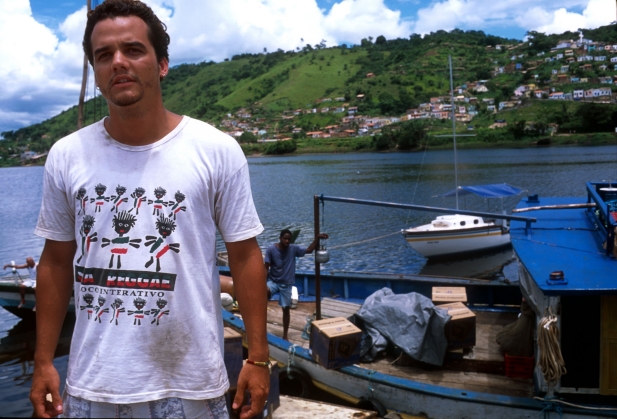
Lower City (Cidade Baixa) is a gutsy and challenging film in the vein of City of God. It has a similar energy with frenetic camera work and it’s depiction of people at the lower end of the food chain. It is set on location in various seaports of northeast Brazil, showcasing beautiful vistas (though rarely in postcard fashion) and urban decay that I found very photogenic. It wasn’t as dark or frenzied as City of God.

Producer Walter Salles (The Motorcycle Diaries, Central Station), director Sérgio Machado and writer Karim Ainouz are regular collaborators. Machado wrote for Ainouz’s Madame Sata (2002), which had a limited release in Australia last year and both Machado and Ainouz wrote for Salles’ Behind The Sun (1998). The style and subject of Lower City had much in common with Madame Sata, though the latter was based on a true character (Madame Sata was a bandit-turned-transvestite performer earlier last century).

Right from the start, sex is a confronting element of Lower City, as we follow the exploits of a lascivious young woman, Karinna (Alice Braga). She is unnervingly blasé about selling herself in exchange for a ride with a pair of men, Deco (Lázaro Ramos) and Naldinho (Wagner Moura) on their boat to Salvador.

Deco and Naldinho are lifelong friends and strugglers. We get glimpses into their questionable background. One is attempting to reform while the other appears to be sinking into bad habits. This is not their only conflict. While they profess their brotherly love for each other, jealously grows over each man’s sexual interest in Karinna.

Deco and Naldinho are of different races. An early scene of a cock fight between a black and a white bird seems prophetic. The deterioration of their relationship was a major focus of the story, and it was well detailed with subtlety. Much of it was by body language such as glaring looks rather than the spoken word. The actors’ performances were all passionate, credible and their characters well-developed and interesting. The film’s depiction of the darker side of a society was a fresh change to the homogenous, polished middle-class of Hollywood.

The film seemed to struggle slightly at times with continuity and editing but remained emotionally gripping throughout. The camera work was mostly hand-held and I found it a bit jolting at times. The exotic music – a sort of neo-Afro-jazz – was a terrific blend of traditional and contemporary and was used to very good effect.

There was a satisfying level of ambiguity in the film, both in motives and the finale. We are not handed everything on a plate for immediate consumption, so we can come out of the cinema ruminating about the experience.

Eroticism is a significant but incidental element in the film, used as a vehicle for revealing aspects of the characters, and how destructive it can be to a relationship. While love triangles are not a new subject, its depiction in Lower City was achieved with depth, originality, realism and emotional honesty. This aspect was a little reminiscent of the scenario in Y Tu Mama Tambien, but in a deeper and much seedier way.

Lower City, despite its depictions of sex and violence, is at heart both gentle and non-judgmental. For me, it didn’t reach the greatness of City of God (to which it is being compared), though it really is a very different film. Serious film-goers will appreciate it for its sensual and raw eroticism, ambiguity, grittiness, sense of humanity and emotional depth. It is well worth seeing.


Dir: Sérgio Machado Rating: R Duration: 98 min Genre: drama Language: Portuguese Country: Brazil Release: 30/11/06, limited Dist: Madman Films Prod Co: VideoFilmes Prod: Mauricio Andrade Ramos, Walter Salles Scr: Sérgio Machado, Karim Ainouz Sound Des: Leandro Lima, Rômulo Drummond Phot: Toca Seabra Ed: Isabela Monteiro de Castro Prod Des: Marcos Pedroso Mus: Carlinhos Brown, Beto Villares Cast: Lázaro Ramos, Wagner Moura, Alice Braga, José Dumont

Official website IMDB

Saturday, October 14, 2006

Shortbus


This film is outrageous, offensive and sure to have decent-minded audiences storming out of cinemas in disgust. However, those who don’t mind a cinematic challenge can stray outside their comfort zones and enjoy what amounts to a whole lot of fun.

Shortbus, the name of a fictional New York 'alternative' club, is an unusual film. It has a blend of audacity, fun, frivolity, seriousness and drama that the broad-minded may find immensely entertaining but will disgust others. Though perverse at times, it is refreshingly different to what is normally on offer. The story has substance and includes interesting characters, including a sex therapist who has never had an orgasm, her frisky husband, a dominatrix who can’t connect emotionally and a gay couple who consider introducing a third man to their relationship. I don’t agree with the theme of sexual liberation, but felt it was worth depicting.

The distributor claims Shortbus contains the most explicit sex in a film with an ‘R’ rating. As I recollect, Baise Moi (French for “fuck me”) contained much more graphic (and violent) sex. Its initial ‘R’ classification was subsequently revoked, a matter of controversy at the time. However, there really is no comparison – Baise Moi was a trashy porno flick (which wasn't even listed on IMDB) and Shortbus is superior in every respect.

During the screening, I found myself asking “why are we as a society so easily offended by sexuality, yet we line up en masse to see people shot and blown to pieces?” We've become so blasé about violence but shy away from carnality. The film depicts a fair bit of sex and it is very much 'in your face'. But it was not the major part of the film – there is a whole lot more going on regarding relationships, hang-ups and neuroses.

The film is set in New York which always looks good on the big screen. There is some novel animation that is used to good effect, especially during the opening and closing sequences. The film could have benefited from some tighter editing (ten minutes could have been cut towards the end), but was mostly quite snappy.

Several films have been lauded in recent times for being quirky, like Chumscrubber, Brick and Little Miss Sunshine. I found those films quite boring and contrived, but Shortbus is truly quirky, original and interesting. If you’re feeling just a little bit adventurous, go see this film before the killjoys lobby the OFLC to have its classification revoked. It’ll have you laughing your head off one minute, and crying the next.


Dir, Scr: John Cameron Mitchell Rating: R Duration: 102 min Genre: drama/comedy Language: English Country: USA Release: 9/11/06, limited Viewed: 13/10/06, Cinema Nova, distributor's advance screening Dist: Hopscotch Prod Co: Q Television, Process Prod: Howard Gertler, Tim Perell, John Cameron Mitchell Sound Des: Benjamin Cheah Phot: Frank G. DeMarco Ed: Brian A. Kates Prod Des: Jody Asnes Mus: Yo La Tengo Cast: Sook-Yin Lee, Paul Dawson, Lindsay Beamish, PJ DeBoy, Raphael Barker, Jay Brannan, Peter Stickles, Justin Bond

Official website IMDB